

 Laptops
 Phones & tablets
 Desktops
 Computer Parts
 Accessories
A laptop can be excellent for office work and still struggle with Photoshop, Premiere Pro, or video editing. Here’s what creators should actually look for before buying.
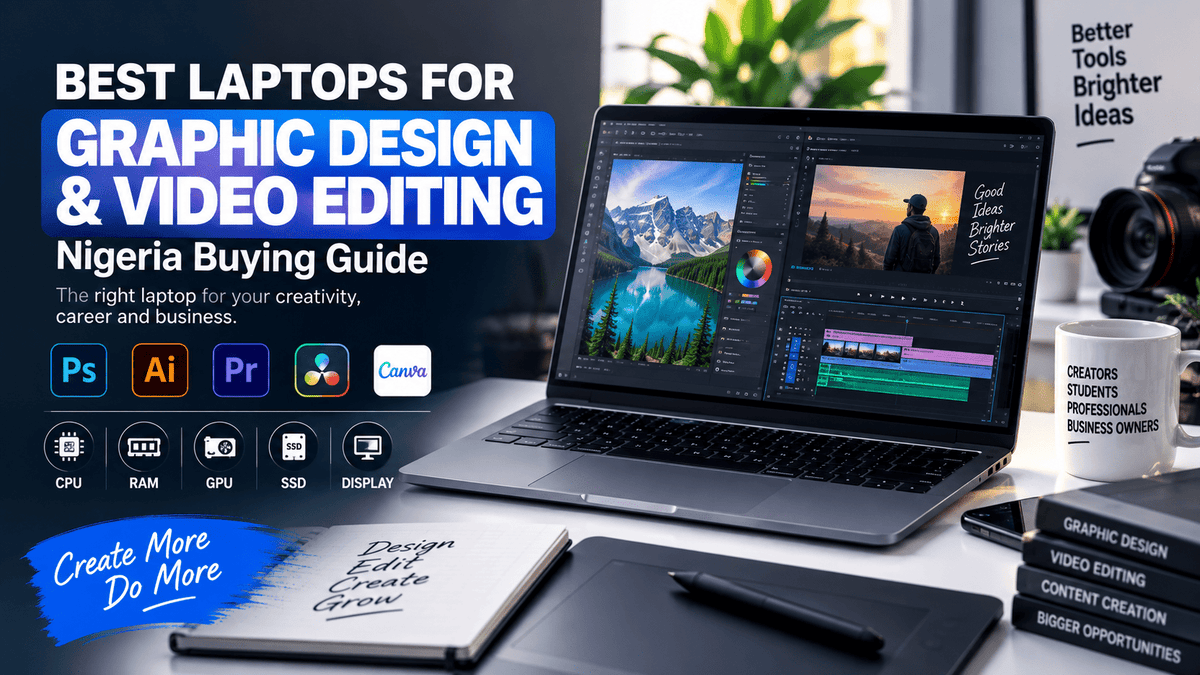
Best Laptops for Graphic Design & Video Editing in Nigeria
16GB RAM does NOT automatically make a laptop good for video editing.
Neither does seeing "Core i7" written in the specifications.
And a laptop having an SSD doesn't necessarily mean it can comfortably handle serious graphics work.
This is one of the biggest mistakes people make when buying laptops for creative work.
A laptop that is extremely fast for:
- Microsoft Word
- Excel
- Browsing
- Accounting
- Zoom meetings
can still struggle badly when you open:
- Adobe Photoshop
- Adobe Illustrator
- Adobe Premiere Pro
- After Effects
- DaVinci Resolve
- Blender
- Other demanding creative applications
Why?
Because creative workloads depend on several components working together.
The processor matters.
RAM matters.
The graphics processor matters.
Storage matters.
And even the display matters.
So before spending hundreds of thousands of naira on a laptop because someone told you it is a “graphics laptop,” here's what you should understand.
First: What Type of Creative Work Do You Actually Do?
Not every graphic designer or video editor needs the same laptop.
Someone designing Instagram flyers with Canva has completely different requirements from someone editing 4K wedding videos in Premiere Pro.
Before buying, identify which category describes you.
Basic creative work
This includes:
- Canva
- Social media graphics
- Basic photo editing
- Lightroom
- Simple Photoshop designs
- Thumbnails
- Flyers
- Logo work
- Basic short-form content
For these tasks, you don't necessarily need a powerful dedicated NVIDIA graphics card.
A modern Core i5, Ryzen 5, or better processor with 8GB–16GB RAM and SSD storage can handle many everyday creative tasks comfortably.
Intermediate graphic design
This includes:
- Adobe Photoshop
- Illustrator
- Lightroom
- Multiple large files
- More complex designs
- Brand identity projects
- Print designs
- Moderate photo manipulation
Here, I would start looking seriously at:
16GB RAM
SSD storage
A good Full HD display
A stronger processor
And depending on the software and the complexity of your work, dedicated graphics can be useful.
Video editing
Once you move into Adobe Premiere Pro, DaVinci Resolve, and other video-editing applications, laptop requirements rise considerably.
Adobe's current Premiere requirements list 8GB of RAM as the minimum, but recommends 16GB of RAM for HD media and 32GB or more for 4K and higher-resolution work. Adobe also recommends a fast internal SSD and says GPU memory is important for demanding workflows.
That distinction is important:
“Can run Premiere Pro”
is not the same as:
“Can edit smoothly in Premiere Pro.”
The 6 Laptop Specifications Creators Should Understand
1. Processor: Don't Look at Core i7 Alone
Many buyers see:
Core i7
and immediately assume they have found a powerful editing laptop.
That's not enough information.
You should ask:
Which generation?
Which exact processor?
Is it a low-power U-series processor or a higher-performance H-series processor?
For demanding creative applications, processor performance directly affects tasks such as:
- Video decoding
- Timeline playback
- Rendering
- Exporting
- Applying effects
- Multitasking
Adobe currently recommends newer processors for Premiere's optimal performance, including Intel 11th Gen or newer CPUs with Quick Sync or suitable AMD Ryzen processors.
This doesn't mean every older laptop suddenly becomes useless.
It means you need to match the laptop to the level of work you intend to perform.
2. RAM: 8GB, 16GB or 32GB?
8GB RAM
Suitable for:
- Canva
- Basic Photoshop
- Basic Illustrator
- Simple content creation
- Light photo editing
For serious video editing, however, 8GB can quickly become restrictive.
16GB RAM
This is where I would recommend most serious creators start.
16GB gives you much more breathing room for:
- Photoshop
- Illustrator
- Lightroom
- Premiere Pro
- Multitasking
- HD video editing
- Multiple applications running simultaneously
Adobe currently recommends 16GB RAM for HD video workflows in Premiere.
32GB RAM
If you're working regularly with:
- 4K video
- Large Premiere projects
- After Effects
- Heavy multitasking
- Large Photoshop files
- Professional animation
- 3D applications
32GB becomes much more attractive.
Adobe's current recommendation for 4K and higher-resolution Premiere workflows is 32GB RAM or more.
3. Dedicated Graphics: This Is Where Many Buyers Get Confused
You may see specifications such as:
Intel UHD Graphics
AMD Radeon Graphics
NVIDIA GTX 1650 4GB
NVIDIA Quadro T1000 4GB
NVIDIA T500 4GB
These are not equivalent.
Integrated graphics share system resources and can be perfectly adequate for lighter creative work.
But dedicated graphics become increasingly important as workloads become more demanding.
Adobe explains that Premiere uses GPU acceleration for tasks including image processing, scaling, effects, and playback. Its current guidance recommends at least 4GB of GPU memory for reliable GPU acceleration, with more desirable for higher-resolution workflows.
This is why a laptop with:
Core i5 + 16GB RAM + 4GB NVIDIA graphics
can sometimes make much more sense for a video editor than another machine advertised simply as:
Core i7 + 16GB RAM
with only basic integrated graphics.
4. SSD Storage Is Almost Non-Negotiable
For creative work, I strongly recommend SSD storage.
A fast SSD improves:
- Windows startup
- Application loading
- Project loading
- Cache performance
- File transfers
- Overall system responsiveness
Adobe also recommends a fast internal SSD for application installation and cache, with additional high-speed storage for media on more demanding workflows.
256GB SSD
Usable, but it can fill quickly once you start storing video footage and project files.
512GB SSD
A much more comfortable starting point for creators.
1TB SSD
Worth considering for frequent video editors, especially if you keep projects locally.
You can also combine your laptop SSD with external SSD storage for completed projects and large footage libraries.
5. Your Display Matters More Than You Think
Many people spend all their time comparing processor and RAM, then ignore the screen.
But if you create visual content, the screen is literally where you make your decisions.
At minimum, I would prefer:
1920 × 1080 Full HD resolution
where your budget allows.
A Full HD display gives you more usable workspace than a basic 1366 × 768 panel.
For professional color-sensitive work, other factors such as:
- Colour gamut
- Colour accuracy
- Brightness
- Contrast
- Panel type
also become important.
If you're producing work for professional print, photography, or color-critical video, consider using a properly calibrated external monitor as well.
6. Cooling Matters
This specification rarely appears in advertisements.
But it matters.
Heavy video editing and rendering can push the processor and GPU to their limits for extended periods.
A slim laptop designed mainly for office productivity may be powerful in short bursts but may struggle to maintain peak performance during longer workloads due to heat.
Performance laptops, gaming laptops, and mobile workstations generally have cooling systems designed for heavier workloads.
That is one reason a workstation or gaming laptop can make sense for creators even if you don't play games.
So, Which Laptops Should Creators Consider?
1. Lenovo ThinkPad T14s Ryzen 5 PRO — Good for Entry-Level Creators
Current configuration
- AMD Ryzen 5 PRO 4650U
- 6 cores / 12 threads
- 16GB RAM
- 256GB SSD
- AMD Radeon Graphics
- 14-inch Full HD 1920 × 1080 display
- Backlit keyboard
Best suited for:
- Canva
- Photoshop
- Illustrator
- Lightroom
- Social media content
- Web design
- Basic video editing
- Students learning graphic design
The biggest attraction here is 16GB RAM combined with a six-core Ryzen processor at a much lower price point than a dedicated-GPU workstation.
But don't confuse it with a heavy video-editing workstation.
Its integrated Radeon graphics make it more suited for graphic design, general creative work, and lighter video editing than demanding professional 4K workflows.

2. Lenovo IdeaPad Gaming 3 — Strong Value for Video Editors
Current configuration
- 11th Gen Intel Core i5-11300H
- 16GB RAM
- 512GB SSD
- 4GB NVIDIA GeForce GTX 1650
- 15.6-inch Full HD 1920 × 1080 display
- Backlit keyboard
Shopinverse currently lists this model with an H-series Core i5 processor and a dedicated 4GB GTX 1650 graphics card.
This is where the specifications start becoming much more interesting for video editors.
Why?
Because you get:
H-series CPU + 16GB RAM + 512GB SSD + dedicated 4GB NVIDIA graphics.
That combination is much better aligned with creative applications than a typical office laptop.
Suitable for:
- Photoshop
- Illustrator
- Lightroom
- Adobe Premiere Pro
- 1080p video editing
- Social media video production
- YouTube editing
- Content creation
- Programming
- Some 3D work
Best for:
Creators who want serious performance without immediately jumping into workstation pricing.

3. Dell Precision 5540 Core i7 — Professional Mobile Workstation
Current configuration
- 9th Gen Intel Core i7
- 16GB RAM
- 512GB SSD
- 4GB NVIDIA dedicated graphics
- 15-inch-class display
- Backlit keyboard
Shopinverse currently lists this Precision 5540 configuration as a premium mobile workstation with dedicated 4GB NVIDIA graphics.
Dell's Precision family is designed around professional workloads rather than ordinary office use.
That's why machines like this are especially interesting to:
- Architects
- Engineers
- Graphic designers
- Video editors
- 3D professionals
- CAD users
- Professional creators
Best for:
Someone who wants workstation-class hardware for both creative and professional applications.
This is also a good example of why a used premium workstation can sometimes be more useful to a creator than buying a brand-new low-end consumer laptop simply because it is new.

Not sure which laptop can handle your creative work?
Tell Shopinverse the software you use and your budget, and we'll help you choose an appropriate option.
4. Dell Precision 5540 Core i9 + Quadro T2000 — For Heavier Professional Work
Another Precision 5540 configuration currently listed by Shopinverse steps up to:
- 9th Gen Intel Core i9
- 16GB RAM
- 512GB SSD
- 4GB NVIDIA Quadro T2000
- Full HD display
- Backlit keyboard
Shopinverse currently lists this Core i9 configuration at ₦840,000.
This is far beyond what a basic Canva designer needs.
It becomes more relevant when your livelihood depends on heavier applications, and you routinely handle:
- Video editing
- CAD
- Engineering applications
- 3D workflows
- Rendering
- Large design projects
- Professional multitasking
One important note
If you're working regularly with very large 4K projects, consider upgrading to 32GB RAM where the laptop configuration and upgrade path permit it.
The CPU and GPU are important, but professional workflows can quickly consume memory.

View Dell Precision 5540 Core i9
5. Dell XPS 15 7590 — Great for Creators Who Want Performance + Premium Design
Current configuration
- 9th Gen Intel Core i7
- 16GB RAM
- 512GB SSD
- 4GB NVIDIA GTX graphics
- 15-inch display
- Backlit keyboard
The current Shopinverse listing combines an H-series Core i7 with 16GB of RAM, a 512GB SSD, and a dedicated NVIDIA graphics card.
The XPS is particularly attractive to creators who want performance without carrying something that looks like a large traditional workstation or gaming machine.
Suitable for:
- Adobe Photoshop
- Illustrator
- Lightroom
- Premiere Pro
- Content creation
- Photography
- Video editing
- Programming
- Professional productivity
Best for:
Creators who want a premium-looking laptop that can still handle serious creative work.

6. HP ZBook Firefly 14 G8 — Portable Workstation for Mobile Creators
Shopinverse currently has a ZBook Firefly 14 G8 configuration featuring:
- 11th Gen Intel Core i7
- 16GB RAM
- 512GB SSD
- 4GB NVIDIA T500
- 14-inch display
- Backlit keyboard
The important difference here is portability.
Many powerful creator laptops are large 15.6-inch or 17-inch machines.
The Firefly gives you workstation-oriented hardware in a smaller 14-inch format.
Best for:
- Designers who travel
- Photographers
- Mobile professionals
- Content creators
- Business owners who also create content
- Video editors who value portability
If you're constantly moving between the office, client locations, shoots and meetings, this form factor can make a lot of sense.

Browse Shopinverse High-Performance Laptops
Gaming Laptop or Workstation: Which Is Better for a Creator?
This is an excellent question.
And the answer is:
It depends on your software and workflow.
Gaming laptops
Gaming laptops can be excellent for creators because they often give you:
- Powerful H-series processors
- Dedicated NVIDIA graphics
- Strong cooling
- Upgradeable RAM
- High-performance SSDs
A machine like the Lenovo IdeaPad Gaming 3 can therefore make a very good editing laptop even if you never install a single game.
Mobile workstations
Workstations such as Dell Precision and HP ZBook machines are designed more specifically around professional workloads.
They can offer:
- Professional NVIDIA graphics
- Business-grade construction
- Workstation-oriented components
- Better suitability for some CAD, engineering, and professional applications
For pure price-to-performance video editing, a gaming laptop can be very attractive.
For broader engineering, CAD, design, and professional creative work, a workstation may make more sense.
Do You Really Need Dedicated Graphics for Photoshop?
Not always.
If your primary work is:
- Canva
- Basic Photoshop
- Illustrator
- Lightroom
- Social media graphics
you can still accomplish a lot with a good modern processor, 16GB RAM, and capable integrated graphics.
This is why something like the Ryzen 5 PRO ThinkPad T14s can still be a practical creator laptop.
But as your projects become more complex, or you add video editing, effects, 3D work, and GPU-accelerated features, the case for a dedicated graphics card becomes stronger.
What About Premiere Pro?
For Premiere Pro, I would take graphics much more seriously.
Adobe says Premiere uses GPU acceleration for numerous playback, image-processing, scaling, and effects tasks. Its current recommendation for reliable GPU acceleration starts at around 4GB of VRAM, while its broader recommended specifications call for more GPU memory for higher-end workflows.
For someone buying primarily for Premiere, I would therefore look harder at machines such as:
Lenovo IdeaPad Gaming 3 — GTX 1650 4GB
Dell XPS 15 7590 — NVIDIA GTX 4GB
Dell Precision 5540 — NVIDIA 4GB
HP ZBook Firefly 14 G8 — NVIDIA T500 4GB
rather than choosing an ordinary business laptop based solely on Core i7 branding.
Can an 8GB Laptop Edit Videos?
Yes.
But that's not the same as saying I recommend 8GB for someone buying a laptop specifically for video editing.
For very simple 1080p projects, lightweight applications, and short social-media videos, an 8GB machine may get the job done.
But once you start:
- Opening multiple applications
- Using larger projects
- Adding effects
- Colour grading
- Editing longer footage
- Working with higher resolutions
you will appreciate 16GB quickly.
If video editing is one of your main income-generating activities, 16GB should be your practical starting target.
Is 4GB NVIDIA Graphics Enough for Video Editing?
It can be quite capable for 1080p and moderate creative workloads, depending on the GPU model, software, codecs, and complexity of the project.
However, “4GB graphics” alone doesn't tell you everything.
A 4GB graphics card from one generation or class is not automatically equal to another.
Still, for buyers moving from integrated graphics into dedicated creative hardware, 4GB of NVIDIA VRAM represents a meaningful step up.
Adobe's current guidance recommends at least 4GB GPU memory for reliable GPU-accelerated Premiere performance.
For more demanding 4K work, higher-end GPUs and more VRAM become increasingly desirable.
Is 512GB SSD Enough for Video Editing?
For the operating system, applications, and some active projects, yes.
For a professional editor's entire footage library?
Probably not.
Video files consume storage very quickly.
A sensible setup can be:
Internal 512GB SSD: Windows, applications, cache, and active work.
External SSD / additional storage: Raw footage, completed projects and archives.
If your laptop supports storage upgrades, moving to 1TB can also make life considerably easier.
Don't Ignore the Type of Video You Edit
There is a massive difference between editing:
30-second Instagram videos
and
45-minute multicamera 4K wedding footage.
That's why asking:
“Can this laptop edit videos?”
is too broad.
A better question is:
“Can this laptop comfortably handle MY type of video editing?”
Tell the seller:
- Software you use
- Resolution you edit
- Typical project length
- Whether you use effects
- Whether you work in 4K
- Whether you use After Effects
- Whether you do 3D work
That information makes it much easier to recommend the correct laptop.
What Laptop Should a Beginner Graphic Designer Buy?
You don't need to start with the most expensive workstation available.
If you're learning:
- Canva
- Photoshop
- Illustrator
- Lightroom
- Basic video editing
look for:
Core i5 / Ryzen 5 or better
16GB RAM if your budget permits
256GB or preferably 512GB SSD
Full HD display
A machine such as the Ryzen-powered ThinkPad T14s can therefore make sense for someone entering the creative field.
As your workload grows, you can then move into dedicated NVIDIA graphics.
What Should a Professional Video Editor Buy?
If video editing is how you make money, I would prioritize:
A performance-class CPU
16GB RAM minimum
32GB preferred for heavier 4K work
Dedicated NVIDIA GPU
512GB SSD minimum
Good Full HD or better display
Strong cooling
At that level, the Lenovo gaming laptop, Dell XPS, Dell Precision, and HP ZBook options become much more relevant.
What About Content Creators Who Mostly Use CapCut and Canva?
You probably don't need a giant workstation.
For:
- TikTok
- Instagram Reels
- Facebook videos
- YouTube Shorts
- Canva
- CapCut
- Basic thumbnails
a modern Core i5 or Ryzen 5 laptop with:
16GB RAM + SSD
may already provide a very comfortable experience.
Spend based on what you actually do.
Don't buy ₦1 million worth of hardware because someone on social media said every content creator needs a workstation.
Used Workstation vs Brand-New Budget Laptop
This is where USA-used laptops can become especially interesting.
Suppose the same budget gives you a choice between:
Brand-new entry-level laptop
Basic processor
8GB RAM
Integrated graphics
Consumer build
and
Premium pre-owned workstation
Performance processor
16GB RAM
512GB SSD
Dedicated NVIDIA graphics
Professional-class chassis
For creative workloads, the second option can sometimes offer considerably more useful performance for the money.
But condition matters.
The laptop should be properly tested, accurately described, and supported after purchase.
At Shopinverse, purchases are backed by warranty and after-sales support, and the current high-performance collection includes graphics laptops from Dell, HP, and Lenovo.
Browse High Performance & Graphics Laptops
10 Things to Check Before Buying a Laptop for Graphic Design or Video Editing
- Exact processor model — not just Core i5 or Core i7.
- Processor generation — newer can make a significant difference.
- RAM capacity — 16GB is an excellent target for serious creative work.
- Upgradeability — can you move to 32GB later?
- Dedicated graphics — especially important for heavier video work.
- GPU VRAM — don't stop at “NVIDIA graphics.”
- SSD capacity — 512GB is much more comfortable for creators than 128GB.
- Display resolution — Full HD should be a strong preference.
- Cooling — sustained workloads generate considerable heat.
- Battery health and condition — particularly when buying pre-owned.
And remember:
Never buy a laptop for graphics work based only on the words “Core i7.”
Frequently Asked Questions
What is the best laptop specification for graphic design?
For most graphic designers, a strong starting point is a modern Core i5/Ryzen 5 or better processor, 16GB RAM, SSD storage, and a Full HD display. Dedicated graphics become more useful as the complexity of your applications and projects increases.
Is Core i5 good for graphic design?
Yes. A suitable newer Core i5 can be very good for graphic design. Processor generation, RAM, storage, and graphics configuration matter just as much as the Core i5/Core i7 label.
Is Core i7 necessary for video editing?
No.
A good performance-oriented Core i5, paired with sufficient RAM and a dedicated graphics card, can outperform an inappropriate older or low-power Core i7 configuration for some workloads.
How much RAM do I need for video editing?
For Premiere Pro, Adobe currently lists 8GB as the minimum and recommends 16GB for HD media and 32GB or more for 4K and higher-resolution media.
Do I need NVIDIA graphics for Photoshop?
Not necessarily for basic Photoshop work.
But dedicated graphics become increasingly useful when your workflow includes video editing, GPU-accelerated features, 3D work, or more demanding creative applications.
Is a gaming laptop good for video editing?
Yes.
Gaming laptops often have powerful CPUs, dedicated GPUs, strong cooling, and fast storage. The same characteristics that can benefit video editing.
Is a workstation laptop better than a normal laptop for creators?
For demanding professional work, it can be. Workstations are designed for heavier workloads and often include dedicated professional graphics cards. But they aren't necessary for every Canva user or beginner designer.
Is 256GB SSD enough for graphic design?
It can be sufficient for applications and smaller projects, but 512GB gives creators much more room. Video editors in particular should consider larger internal storage or external SSDs.
Shop Laptops for Graphic Design & Video Editing
Browse high-performance laptops with SSD storage, powerful processors and dedicated graphics.
Browse Shopinverse High-Performance Laptops
Final Verdict
There is no single laptop that is perfect for every designer or video editor.
The right choice depends on what you create.
For Canva and basic graphic design, you don't necessarily need a dedicated NVIDIA graphics card.
For Photoshop and Illustrator, prioritize a good processor, sufficient RAM, an SSD, and a quality display.
For Premiere Pro and serious video editing, start paying much more attention to:
Processor performance + RAM + dedicated GPU + VRAM + SSD + cooling.
And for professional 4K editing, CAD, rendering, and demanding creative workflows, consider a workstation or high-performance laptop rather than a standard office machine.
Most importantly:
Don't ask only, “Is it a Core i7?”
Ask:
Which Core i7?
How much RAM?
Which graphics card?
How much VRAM?
SSD or HDD?
What display?
And can it handle the software I actually use?
Those questions will help you make a much smarter buying decision.
Share:
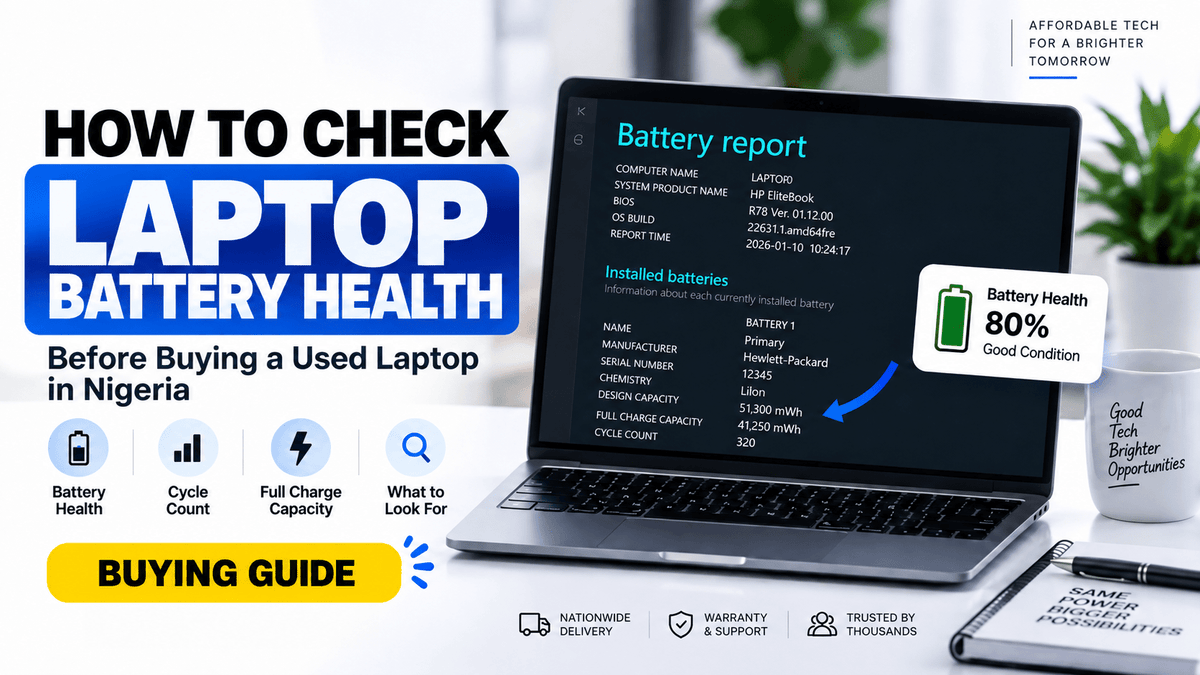
How to Check Laptop Battery Health Before Buying a Used Laptop in Nigeria