

 Laptops
 Phones & tablets
 Desktops
 Computer Parts
 Accessories
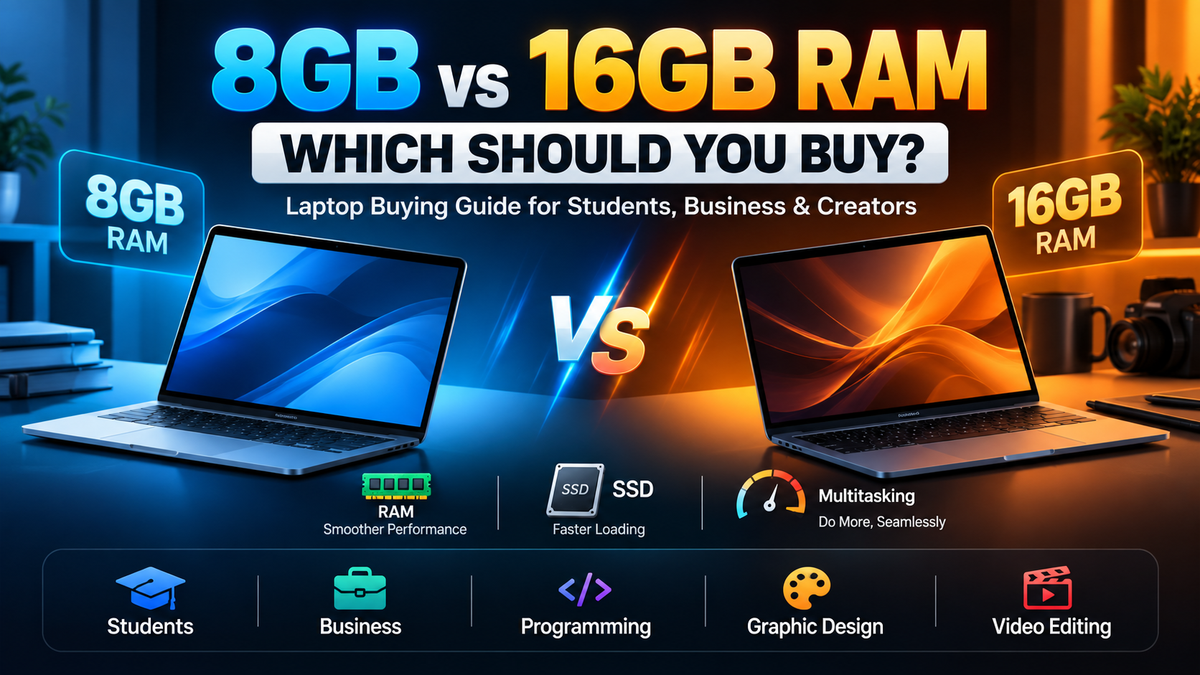
Before paying extra for 16GB RAM, find out whether you actually need it. The answer might save you money, or prevent you from buying the wrong laptop.
Imagine you're about to buy a laptop.
The seller shows you two options.
Laptop A: Core i5, 8GB RAM, 256GB SSD.
Laptop B: Core i5, 16GB RAM, 256GB SSD.
Both have similar specifications, but Laptop B costs more.
Naturally, you start wondering:
Should I pay extra for 16GB RAM, or will 8GB do everything I need?
Here's the interesting part.
More RAM doesn't automatically mean a faster laptop.
If your main activities are browsing, typing documents, watching movies and checking emails, 8GB RAM may be perfectly adequate.
But if you're constantly running multiple applications, editing videos, programming or working with demanding software, 16GB RAM can make a noticeable difference.
And sometimes, even 16GB isn't enough.
So before spending your hard-earned money, let's explain what RAM actually does, how much you need for different activities, and how to choose the right laptop for your budget.
What Is RAM, and Why Does It Matter?
RAM stands for Random Access Memory.
Think of RAM as the working space on your office desk.
Your laptop's storage drive is like a filing cabinet where your documents, photos, applications and other files are kept.
RAM is the desk space where you temporarily place the things you're currently working on.
Imagine you're running a small business. On your desk, you have:
- Your sales records
- Customer invoices
- A calculator
- Your inventory book
- A notebook
- Your phone
If your desk is too small, you constantly have to move things around before you can continue working.
But with a larger desk, you can keep more things available at once.
That's essentially what additional RAM helps your laptop do.
The more demanding applications you run simultaneously, the more RAM you may need.
When available RAM becomes insufficient, Windows can move some information into storage temporarily. This is called paging.
Although SSDs help, accessing information from storage is generally much slower than accessing RAM.
That's one reason a computer can become noticeably sluggish when its memory is heavily occupied.
Is 8GB RAM Enough for a Laptop?
Suitable for everyday computing
For many everyday users, yes.
A properly configured laptop with 8GB RAM can comfortably handle a wide range of common activities.
These include:
- Microsoft Word, Excel and PowerPoint
- School assignments and research
- Browsing with a moderate number of tabs
- Email and WhatsApp Web
- YouTube and online entertainment
- Accounting and inventory applications
- Online meetings
- Basic programming
- Canva and light graphic design
For example, a student using a laptop mainly for assignments, research, presentations and online classes might not notice a dramatic difference between 8GB and 16GB RAM during light use.
The same applies to a business owner who mainly uses Excel, email, inventory software and a few browser tabs.
Microsoft lists 4GB RAM as the minimum for Windows 11, but minimum system requirements are not the same as a recommendation for comfortable multitasking.
For a Windows laptop you're buying for regular everyday use, 8GB is a more practical starting point than 4GB.
When 8GB RAM Starts Becoming Restrictive
Problems can appear when you begin combining many tasks.
Imagine you have:
- Chrome with numerous tabs open
- Microsoft Excel running
- WhatsApp Web active
- A Zoom meeting in progress
- Canva open in another browser tab
- Photoshop running in the background
An 8GB laptop may begin to struggle depending on the applications, file sizes and available memory.
This doesn't necessarily mean its processor is bad.
It may simply need more RAM.
Is 16GB RAM Worth the Extra Money?
More room for multitasking
For users who regularly multitask or work with demanding applications, 16GB is a worthwhile upgrade.
It gives Windows and your applications more room to operate without constantly competing for limited memory.
Consider a business owner who handles:
- Excel spreadsheets
- Multiple browser tabs
- Accounting software
- WhatsApp Web
- Canva
- Online meetings
- Customer records
If these applications are frequently open together, moving from 8GB to 16GB can improve responsiveness when the computer is running short of memory.
It also gives you more room for future software requirements.
Who Should Seriously Consider 16GB?
I would prioritize 16GB for people who regularly use laptops for:
- Programming
- Graphic design
- Substantial multitasking
- Larger spreadsheets
- Content creation
- Demanding business applications
But remember:
16GB cannot compensate for a very weak processor, failing storage drive or unsuitable graphics hardware.
The laptop still needs to be well balanced.
What About 32GB RAM?
For more demanding workloads
There is a point where 16GB becomes restrictive.
For example, someone editing high-resolution video while keeping several professional applications open may benefit substantially from 32GB.
The same applies to certain programmers, engineers and professionals who use virtual machines, large datasets or demanding development tools.
Adobe's Premiere technical requirements recommend 16GB RAM for HD editing and 32GB or more for 4K and higher-resolution work.
That doesn't mean every video editor needs 32GB.
It means the memory you need depends on the complexity of your projects.
For someone using Word, Excel and Chrome, spending significantly more for 32GB may offer little noticeable benefit.
How Much RAM Do You Need for Different Activities?
This is the most important part of the buying guide.
1. Students: 8GB or 16GB?
For most students, 8GB RAM is a practical starting point.
If your daily activities include typing assignments, browsing, research, presentations, online classes and watching educational videos, a laptop with 8GB RAM and SSD storage can serve you well.
However, your course of study matters.
A student learning computer science, engineering, animation or architecture may eventually need more memory.
Our recommendation: Start with 8GB for general schoolwork. Consider 16GB for technical courses, heavier multitasking or longer-term flexibility.
2. Small Business Owners: 8GB or 16GB?
Let's use a Nigerian small-business owner as an example.
You run a shop and use your laptop for inventory, sales reports, invoices, WhatsApp Web, online banking and customer management.
A good 8GB laptop can handle many of these activities.
But perhaps your business is growing.
You're now running several browser-based business applications, managing large Excel files, attending video meetings and designing promotional materials simultaneously.
At that point, 16GB becomes more attractive.
Our recommendation: 8GB for straightforward business tasks; 16GB for substantial multitasking or more demanding business software.
A faster laptop can make daily work easier, but there is no need to spend extra on memory you rarely use.
3. Programmers: Is 8GB RAM Enough?
It depends on what you're building.
If you're learning HTML, CSS, JavaScript or Python, 8GB can be sufficient for many beginner projects.
However, programming environments can become demanding.
A developer might have a code editor, local development server, browser, database, documentation and several other tools running simultaneously.
More advanced development might involve Docker containers, virtual machines or Android emulators.
Our recommendation: 16GB for a comfortable general-purpose programming laptop. Consider 32GB for memory-intensive development environments.
Your processor, storage and software requirements still matter.
4. Graphic Designers: Is 16GB Necessary?
For basic Canva designs, social-media graphics and lighter photo editing, 8GB may be sufficient.
But if you're regularly working with Photoshop, Illustrator, Lightroom and larger design projects, 16GB is preferable.
Adobe's Photoshop requirements list 8GB RAM as the minimum and recommend 16GB or more.
For designers, display quality also deserves attention.
A Full HD screen is helpful, while colour accuracy becomes particularly important for professional photo and print work.
Our recommendation: 16GB for regular professional graphic design. More may be appropriate for very large documents and complex multitasking.
5. Video Editors: 8GB, 16GB or 32GB?
This is where choosing the right RAM becomes particularly important.
Editing a short social-media video is very different from editing a large 4K wedding project.
For basic editing, 8GB may be workable with appropriate software and simple projects.
For regular HD editing, 16GB is a much stronger starting point.
For demanding 4K projects, complex effects and professional workflows, 32GB or more becomes increasingly worthwhile.
However, don't buy a 32GB laptop and ignore the graphics card.
Video editing can depend heavily on processor performance, GPU capability, available VRAM and storage speed too.
Our recommendation: 16GB for regular HD video work; consider 32GB or more for demanding professional workflows.
6. Gamers: Is 16GB RAM Enough?
For many games, 16GB is a sensible starting point.
Some lighter games can run with 8GB, while demanding titles, heavily modified games or gaming alongside streaming software can benefit from more memory.
But gaming performance depends heavily on the graphics processor.
For example, a laptop with 32GB RAM and weak integrated graphics is not automatically a better gaming machine than a suitable 16GB laptop with a dedicated NVIDIA GPU.
Our recommendation: Start by checking the game's official system requirements. Consider 16GB for a general-purpose gaming laptop and more where your games or streaming workload justify it.
7. Office Workers: Do You Really Need 16GB?
If your daily work involves Word, Excel, PowerPoint, email, browser applications and online meetings, 8GB may be enough.
But if you work with large spreadsheets, complex business software or dozens of browser tabs, 16GB can make multitasking more comfortable.
Our recommendation: Don't pay extra for 16GB just because another person says 8GB is outdated. Consider what your actual workload requires.
8GB RAM + SSD vs 16GB RAM + HDD: Which Is Better?
This is one of the most misunderstood laptop comparisons.
Imagine you have two laptops with the same processor.
Laptop A
8GB RAM256GB SSD
Laptop B
16GB RAM500GB HDD
Which would you buy?
Many people immediately choose Laptop B because it has twice the RAM and more storage capacity.
But they are overlooking something important.
RAM and storage perform different jobs.
RAM helps your computer manage active applications and data.
An SSD stores Windows, programs, documents and other files, while providing much faster access than a traditional mechanical hard drive.
If you're mainly browsing, typing and using common office applications, Laptop A may feel more responsive during startup and application loading because of its SSD.
Laptop B has more memory, but its HDD can slow down everyday storage-related operations.
However, if your workload actually needs more than 8GB of memory, Laptop B's additional RAM could be useful, even though its HDD remains a disadvantage.
What Should You Buy?
For most everyday Windows buyers, I would prioritize getting an SSD first, then ensure the laptop has enough RAM for your workload.
An excellent all-round combination is:
But an 8GB laptop with an SSD is still a reasonable purchase when it meets your needs and budget.
Does More RAM Make a Laptop Faster?
Sometimes.
But not always.
Here's a simple example.
You use a laptop with 8GB RAM.
You normally run only Microsoft Word and a few browser tabs.
You upgrade it to 16GB.
Will Word suddenly become twice as fast?
No.
You may notice little difference because your original workload wasn't running out of memory.
Now imagine another person using the same laptop.
They regularly run Chrome, Excel, Zoom, Photoshop and other applications simultaneously.
Their 8GB laptop frequently becomes sluggish.
Upgrading to 16GB may make a substantial difference because their workload can now fit more comfortably into memory.
More RAM helps most when insufficient RAM was causing the problem.
It does not double your processor speed, increase your internet speed or automatically make your graphics card more powerful.
Core i5 With 16GB RAM vs Core i7 With 8GB RAM
This is another interesting buying decision.
Imagine:
Laptop A: Core i5, 16GB RAM, 256GB SSD.
Laptop B: Core i7, 8GB RAM, 256GB SSD.
Which is better?
You cannot answer properly without checking the exact processors and intended use.
For an application that depends primarily on CPU performance and fits comfortably within 8GB RAM, the Core i7 may perform better if its actual processor is stronger.
But for a memory-intensive workload, the Core i5 with 16GB may provide a more comfortable experience.
A newer-generation Core i5 might also outperform an older Core i7 in certain tasks.
This is why you should never buy a laptop based on one specification alone.
Processor + RAM + SSD + graphics + your workload should determine your decision.
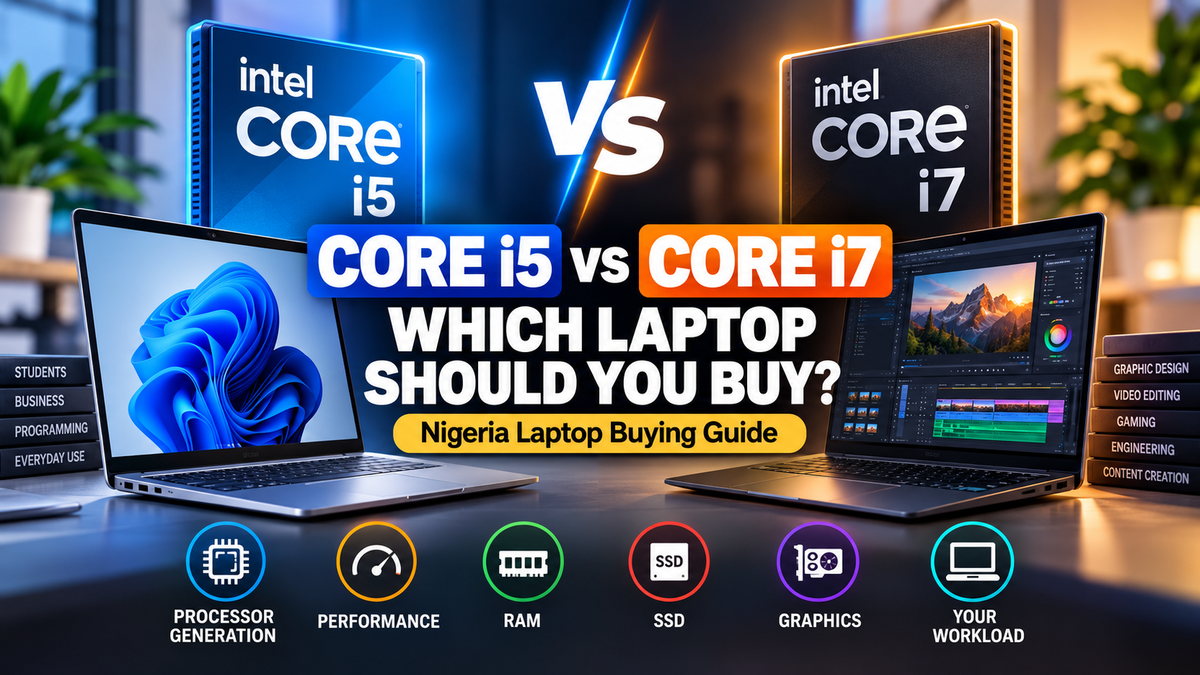
For a deeper explanation, read our guide on Core i5 vs Core i7: Which Laptop Should You Buy in Nigeria?
Can You Upgrade an 8GB Laptop to 16GB Later?
Sometimes, yes.
But this is something you should check before buying, especially when shopping for a used laptop.
There are three common situations.
1. Replaceable RAM
Some laptops have removable RAM modules.
For example, a laptop may come with one 8GB module and support upgrading to 16GB.
Depending on its specifications, you might replace the existing module or install another compatible module.
2. Soldered RAM
Some laptops have memory permanently attached to the motherboard.
These laptops may not allow a conventional RAM upgrade.
If you buy an 8GB version, you might be stuck with 8GB.
This is particularly important when choosing slim premium laptops.
3. Partially Soldered RAM
Some models combine soldered memory with an additional upgradeable slot.
Your upgrade options depend on the exact model.
Before purchasing, ask the seller:
"Is the RAM upgradeable, and what is the maximum supported capacity?"
Also check whether the laptop uses compatible DDR3, DDR4, DDR5 or another memory type.
You cannot simply install any RAM module into any laptop.
How to Check How Much RAM Your Laptop Has
You don't need to install special software just to check your installed RAM.
On Windows, follow these steps.
Step 1: Open Settings
Click Start and open Settings.
Step 2: Open System
Navigate to:
System → About
Step 3: Check Installed RAM
Look for the section displaying your device specifications.
You should see something similar to:
Installed RAM: 8.00GB
or
Installed RAM: 16.00GB
That's your installed memory.
Want More Information?
Open Task Manager and select:
Performance → Memory
Depending on your hardware, Windows may display information such as memory speed, available memory and the number of memory slots in use.
This is also useful for checking whether your laptop regularly approaches its available memory limit.
If you're frequently using almost all your RAM and experiencing slowdowns, upgrading may be worth investigating.
However, Task Manager doesn't always provide complete upgradeability information. Confirm your laptop's exact specifications before purchasing replacement memory.
Recommended Shopinverse Laptops: 8GB, 16GB and 32GB RAM
Now that you understand the difference, let's look at actual laptop configurations.
These examples illustrate different memory capacities. They are not direct performance comparisons because their processors and other specifications also differ.
Product prices and stock can change, so check the current listings before ordering.
1. Dell Latitude 3410 – 8GB RAM
Everyday productivity
Key Specifications
- 10th Gen Intel Core i5
- 8GB RAM
- 256GB SSD
- 14-inch Full HD display
- 1920 × 1080 resolution
This Shopinverse configuration combines 8GB RAM with SSD storage and a 10th-generation Core i5 processor.
It is a practical option for students, office workers and small-business owners who need a laptop for common productivity tasks.
Best suited for: School, Microsoft Office, business management, browsing and everyday computing.


2. Lenovo ThinkPad T14 Gen 1 – 16GB RAM
Professional multitasking
Key Specifications
- 10th Gen Intel Core i5
- 16GB RAM
- 256GB SSD
- 14-inch Full HD display
- 1920 × 1080 resolution
- Backlit keyboard
The ThinkPad T14 Gen 1 is listed by Shopinverse with a quad-core Core i5-10210U, 16GB RAM and SSD storage.
This configuration provides additional memory for users who frequently run multiple applications.
It is particularly relevant for professionals who combine spreadsheets, business software, research, programming tools and online meetings.
Best suited for: Professional multitasking, business applications, programming and remote work.


3. HP ZBook Firefly 14 G8 – 32GB RAM
Advanced professional workloads
Key Specifications
- 11th Gen Intel Core i7
- 32GB RAM
- 512GB SSD
- 4GB NVIDIA T500 dedicated graphics
- 14-inch Full HD display
- 1920 × 1080 resolution
Shopinverse currently lists this ZBook configuration with 32GB RAM and dedicated NVIDIA graphics.
The combination makes it relevant to professionals who use substantial memory and need a dedicated GPU for compatible creative applications.
However, the presence of 32GB RAM does not mean every demanding task will run equally well.
Processor performance, graphics capability and software requirements still determine what the laptop can handle.
Best suited for: Professional multitasking, development, demanding creative applications and suitable workstation workloads.


Which RAM Should You Choose for Your Budget?
Here's a practical way to decide.
If your budget is limited: A reasonably modern 8GB laptop with SSD storage can be an excellent starting point for everyday work.
If you have room in your budget: Consider 16GB, especially if you regularly multitask or plan to keep the laptop for several years.
If you use demanding professional applications: Investigate whether your workload justifies 32GB or more.
Whatever your budget, avoid buying solely because a laptop has a large amount of RAM.
A poorly balanced machine can still deliver a disappointing experience.
Frequently Asked Questions About Laptop RAM
Is 8GB RAM enough for Windows?
Yes. A laptop with 8GB RAM can handle Windows and many common applications, provided the processor and other specifications are suitable.
Is 16GB RAM twice as fast as 8GB?
No. It provides twice the memory capacity, not twice the processing speed. Performance gains depend on whether your workload needs the additional memory.
Is 8GB RAM enough for programming?
It can be sufficient for learning and lighter development. For more substantial programming, 16GB is a useful starting point. Heavy virtual-machine and development workloads may require more.
Is 16GB RAM enough for graphic design?
For many graphic-design workflows, yes. Adobe recommends at least 16GB for Photoshop, although very large files and complex workflows may benefit from additional memory.
Is 32GB RAM overkill?
For basic browsing and office work, it is often unnecessary. For demanding professional applications, 32GB can be useful.
Can I upgrade an 8GB laptop to 16GB?
Possibly. Check whether the memory is removable or soldered, the available slots and the laptop's supported maximum capacity.
Does RAM affect gaming?
Yes. Insufficient RAM can cause slowdowns, but the processor and GPU also affect gaming performance. Check the requirements of the specific games you intend to play.
Does adding RAM increase battery life?
Not necessarily. Adding RAM primarily increases memory capacity. The effect on battery runtime depends on the system and workload.
Which is better: 8GB RAM with SSD or 16GB RAM with HDD?
For basic everyday use, an 8GB laptop with SSD storage may feel more responsive during startup and application loading.
If your applications need more than 8GB memory, however, the additional RAM can be valuable.
What is the difference between RAM and storage?
RAM temporarily holds data used by active applications. Storage retains files, programs and the operating system.
A laptop with 256GB SSD and 8GB RAM does not have 264GB RAM. These are two different components with different jobs.
Final Verdict: Should You Buy 8GB or 16GB RAM?
Here is the simplest way to understand everything we've discussed.
8GB RAM is not automatically bad.
16GB RAM is not automatically necessary.
32GB RAM is not automatically better for everyone.
Your workload should determine the amount of memory you need.
For most students and everyday office users, 8GB with SSD storage can still be a practical combination.
For professionals, programmers, designers and people who regularly multitask, 16GB provides more room to work.
For memory-intensive professional applications, 32GB or more may be justified.
But remember:
RAM is only one part of the laptop.
Before buying, check the complete combination of processor, memory, storage, graphics, display, battery condition and warranty.
The goal isn't to buy the laptop with the biggest specifications.
The goal is to buy a laptop that comfortably handles what you actually need it to do.

Share: