

 Laptops
 Phones & tablets
 Desktops
 Computer Parts
 Accessories
Core i7 sounds more powerful, but a newer Core i5 can sometimes be the smarter buy. Here’s how to choose the right processor without wasting money.
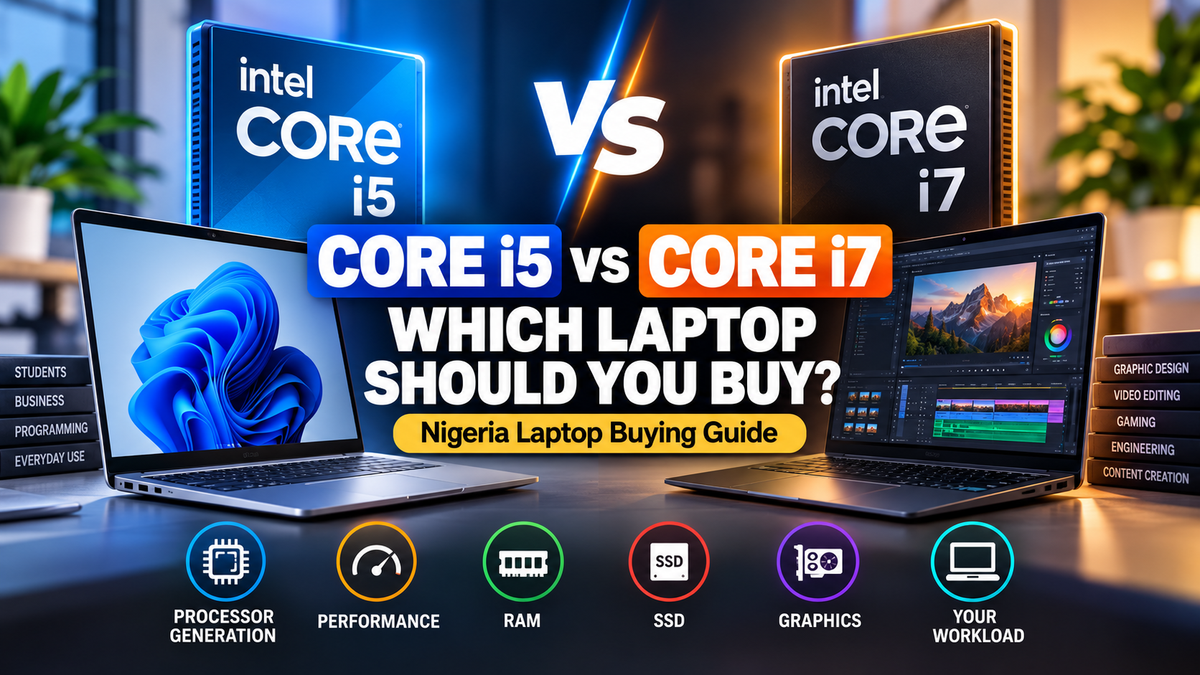
Core i5 vs Core i7: Which Laptop Should You Buy in Nigeria?
You see two laptops.
Laptop A
Intel Core i7
Laptop B
Intel Core i5
Which one would you choose?
Many buyers immediately pick Laptop A.
After all:
i7 is higher than i5, so it must be faster. Right?
Not necessarily.
This is one of the biggest mistakes people make when buying laptops.
A laptop's processor cannot be judged properly by looking at Core i5 or Core i7 alone.
You also need to know:
- Processor generation
- Exact processor model
- Processor series
- Number of cores and threads
- Power class
- Laptop cooling
- RAM
- Storage
- Graphics
- And most importantly, what you actually intend to do with the laptop
That means a newer Core i5 laptop can sometimes be a much better purchase than an older Core i7.
So, before paying extra simply because a laptop says Core i7, here is what you need to understand.
What Do Core i5 and Core i7 Actually Mean?
Core i5 and Core i7 are performance tiers within generations of Intel Core processors.
Generally, within the same processor generation and comparable processor class, Core i7 models tend to offer more performance-related resources or capabilities than Core i5 models.
But that sentence contains two very important words:
Same generation.
An 11th-generation Core i5 and a 6th-generation Core i7 are not simply two versions of the same processor.
They come from very different generations of technology.
Intel itself advises identifying both the processor tier and its generation when comparing processors.
The Biggest Mistake: Looking Only at “Core i7”
Suppose a seller advertises:
HP Laptop – Core i7 – 16GB RAM – 512GB SSD
It sounds impressive.
But an important piece of information is missing:
Which Core i7?
For example:
Core i7-6600U
and
Core i7-1165G7
both say Core i7.
But they belong to completely different processor generations.
Intel's traditional naming system makes the generation identifiable from the numbers following i3, i5, i7, or i9. For example, Intel identifies the i7-8650U as an 8th-generation processor and the i5-10210U as a 10th-generation processor.
This is why you should never stop at:
“Is it Core i7?”
Ask:
“What is the complete processor model?”
How to Know the Generation of an Intel Processor
For many traditional Intel Core processors, the processor number tells you the generation.
Examples:
Intel Core i5-7200U
The 7 at the beginning of 7200 tells you this is a:
7th Gen Core i5
Intel Core i5-8250U
The 8 indicates:
8th Gen Core i5
Intel Core i7-10610U
The 10 indicates:
10th Gen Core i7
Intel Core i5-1145G7
The 11 indicates:
11th Gen Core i5
Intel Core i7-1265U
The 12 indicates:
12th Gen Core i7
Intel documents this same identification method for its traditional Core processor generations.
So is a Newer Core i5 Better Than an Older Core i7?
Sometimes, yes.
But don't turn that into another oversimplified rule.
A newer Core i5 can benefit from improvements in areas such as:
- Processor architecture
- Core configuration
- Power efficiency
- Integrated graphics
- Memory support
- Platform features
- Performance per watt
However, whether it actually beats a particular older Core i7 depends on the exact two processors you're comparing.
This is why:
11th Gen Core i5 vs 8th Gen Core i7
is already a much better comparison than:
Core i5 vs Core i7
But even then, you should compare the specific processor models.
Would You Rather Buy an 8th Gen Core i7 or an 11th Gen Core i5?
This is exactly the kind of question where many buyers get confused.
The wrong approach is:
“i7 is higher, so I will take the i7.”
The better approach is:
Step 1: Get the exact processor model.
Step 2: Compare its generation.
Step 3: Check whether it is a low-power or performance-oriented processor.
Step 4: Compare the complete laptop specifications.
Step 5: Consider what you actually want to do with it.
Depending on the exact chips, the newer Core i5 may provide a more modern overall platform and may be the better choice.
But there are also older Core i7 processors that remain very capable.
The processor name alone is not enough information.
What Do the Letters After the Processor Number Mean?
This is where laptop processor comparisons become even more interesting.
You may see names such as:
Core i5-10310U
Core i7-11800H
Core i7-1265U
Those letters matter.
Intel uses suffixes to distinguish different processor characteristics and product classes. Intel's current processor naming documentation continues to use suffixes such as U and H in its mobile families.
For laptop buyers, two of the most important categories to understand are:
U-Series Processors
U-series processors are commonly designed for thin-and-light laptops where power efficiency and battery life matter.
You'll frequently find them in laptops such as:
- HP EliteBook
- Dell Latitude
- Lenovo ThinkPad
- Ultrabooks
- Business laptops
They are excellent for many everyday users.
Suitable tasks can include:
- Microsoft Office
- Browsing
- Accounting
- School work
- Programming
- Business management
- Remote work
- Everyday productivity
H-Series Processors
H-series processors are generally associated with higher-performance laptops.
You'll often find them in:
- Gaming laptops
- Mobile workstations
- Creator laptops
- High-performance machines
These become more relevant for:
- Video editing
- Rendering
- Heavy programming workloads
- Engineering applications
- 3D applications
- Gaming
- Professional creative work
So even two processors from a similar generation can serve very different kinds of laptops.
Browse High Performance Laptops →
Core i5 vs Core i7 for Students
If you're buying primarily for:
- Assignments
- Microsoft Word
- PowerPoint
- Excel
- Research
- Browsing
- Zoom
- Online classes
- Programming basics
- Watching videos
you usually do not need to chase a Core i7 simply because it sounds more powerful.
A well-configured modern Core i5 with:
8GB or preferably 16GB RAM
SSD storage
and a suitable display
can be an excellent student laptop.
In fact, spending your limited budget on a balanced laptop can be smarter than paying extra for an older Core i7 while compromising on storage, battery condition or other important features.
Best choice for most students:
A reasonably modern Core i5 + SSD + sufficient RAM.
Core i5 vs Core i7 for Small Business Owners
Think about what most business laptops actually do every day:
- Excel
- Invoicing
- Inventory
- WhatsApp Web
- Browser tabs
- Online banking
- Canva
- Accounting software
- Customer records
- Zoom
- Social media management
Most small-business owners do not need the highest-performance processor available.
A good Core i5 can be more than enough.
Instead of spending your entire budget moving from i5 to i7, it may be smarter to prioritize:
16GB RAM
SSD storage
Good battery condition
Full HD display
Comfortable keyboard
Good build quality
Warranty
Core i5 vs Core i7 for Programming
This depends heavily on the type of programming.
For:
- HTML
- CSS
- JavaScript
- Web development
- Python learning
- Basic application development
a modern Core i5 with enough RAM and SSD storage is usually very capable.
But requirements become heavier when you regularly use:
- Virtual machines
- Android Studio
- Large development environments
- Docker containers
- Data analysis
- Machine learning workloads
- Several development tools simultaneously
In those cases, a higher-performance Core i7 can become more attractive.
But again:
RAM can matter just as much.
A Core i7 with only 8GB RAM can become frustrating under heavy multitasking, while a well-configured Core i5 with 16GB RAM may provide a better experience for certain workloads.
Core i5 vs Core i7 for Graphic Design
For Photoshop, Illustrator, Lightroom, Canva, and similar creative applications, both Core i5 and Core i7 laptops can work very well.
You should also consider:
- RAM
- SSD
- Display quality
- Graphics
- Processor generation
A newer Core i5 paired with 16GB RAM and SSD storage can be an excellent graphic-design laptop.
For heavier creative workloads, a Core i7 becomes more attractive, but don't forget the GPU.
>> Best Laptops for Graphic Design & Video Editing in Nigeria
Core i5 vs Core i7 for Video Editing
This is where I'd look beyond ordinary U-series office laptops.
Video editors should consider:
Processor class
RAM
Dedicated graphics
VRAM
SSD storage
Cooling
A Core i7 may be beneficial for demanding editing, but:
Core i7 + integrated graphics
is not automatically better for video work than:
Performance-oriented Core i5 + dedicated NVIDIA graphics
Your editing software and project type matter.
If video editing is your main reason for buying a laptop, see our separate:
Best Laptops for Graphic Design & Video Editing in Nigeria
That guide goes deeper into RAM, GPU, VRAM, SSDs, and workstation laptops.
Core i5 vs Core i7 for Gaming
Gaming performance isn't decided by the CPU alone.
The graphics card often plays an enormous role.
Imagine:
Laptop A
Core i7
Integrated graphics
Laptop B
Core i5
NVIDIA dedicated graphics
For gaming, Laptop B may make far more sense depending on the exact processors and graphics card.
So don't buy a “Core i7 gaming laptop” until you check:
Which GPU does it have?
RAM Can Matter More Than Moving From i5 to i7
Consider:
Laptop A
Core i7
8GB RAM
256GB SSD
Laptop B
Core i5
16GB RAM
512GB SSD
Which one is better?
You still cannot answer correctly from those specifications alone.
But this example shows something important:
Processor tier isn't the only factor affecting your experience.
If you constantly run:
- Many Chrome tabs
- Excel
- Canva
- Zoom
- Photoshop
- Several apps at once
more RAM can sometimes improve your everyday experience more noticeably than simply buying a higher processor badge.
That's why our next guide covers:
8GB vs 16GB RAM: How Much RAM Do You Really Need?
SSD vs HDD Also Matters
Imagine buying an expensive Core i7 laptop with an old mechanical HDD.
Then your friend's Core i5 laptop has an SSD.
Your friend's laptop may feel far more responsive during:
- Startup
- Opening applications
- Loading files
- Searching
- Everyday Windows use
The processor isn't necessarily the problem.
Storage is.
This is why I strongly recommend prioritizing SSD storage for modern everyday laptop use.
Don't Ignore the Laptop's Cooling
A processor does not operate in isolation.
Laptop manufacturers decide:
- Cooling design
- Power limits
- Fan configuration
- Chassis thickness
Two laptops with processors from similar performance classes may behave differently under sustained workloads because one can keep its processor cooler for longer.
This matters particularly for:
- Video editing
- Gaming
- Rendering
- Compiling
- Engineering work
That is another reason comparing only “Core i5” and “Core i7” can be misleading.
A Real Example: Same Laptop Family, Different Processor Tiers
We currently list the Dell Latitude 7430 in both Core i5 and Core i7 configurations.
One current configuration includes:
Dell Latitude 7430 – Core i5
- 12th Gen Intel Core i5
- 8GB RAM
- 256GB SSD
- 14-inch Full HD display
- Backlit keyboard
Another configuration includes:
Dell Latitude 7430 – Core i7
- 12th Gen Intel Core i7
- 32GB RAM
- 256GB SSD
- 14-inch Full HD display
- Backlit keyboard
Both are from the same Latitude generation, but the complete configurations are very different, not merely the i5/i7 label.
That means your decision shouldn't simply be:
“i5 or i7?”
It should be:
“What complete specification do I need, and how much should I spend to get it?”
Best for the Core i5 version
- Students
- Office workers
- Small-business owners
- Everyday productivity
- Remote work
Best for the Core i7/32GB version
- Heavy multitasking
- Developers
- Professionals running demanding applications
- Users who specifically need substantially more memory

Check Current Dell Latitude 7430 Options →
When Should You Actually Pay More for Core i7?
Core i7 makes more sense when your workload can actually use the additional performance.
Examples include:
- Heavy video editing
- 3D rendering
- Engineering applications
- Serious software development
- Large data workloads
- Heavy multitasking
- Professional creative work
- Virtual machines
- Performance-focused computing
If your daily work is mostly:
Chrome + Word + Excel + email + Zoom
you may barely benefit from spending significantly more simply to get an i7 badge.
Put that money into a better overall laptop instead.
When Is Core i5 the Smarter Buy?
Core i5 is particularly attractive when:
You're a student
You need good performance without overspending.
You're running a small business
Your applications are mostly productivity-focused.
You're an office worker
Most of your day is spent in Word, Excel, web browsers, email, and meetings.
You're working within a fixed budget
You can use the savings to get:
- More RAM
- Larger SSD
- Better display
- Newer laptop generation
- Better battery
- Better physical condition
That can result in a much better overall computer.
Don't Buy an Old Core i7 Just to Say You Have Core i7
This deserves emphasis.
Many people choose:
Older Core i7
over:
Newer Core i5
simply because the word i7 sounds more premium.
That can be a mistake.
Older processors may mean an older overall platform too.
That can affect things such as:
- Efficiency
- Integrated graphics
- Connectivity
- Supported technologies
- Age of the machine
- Battery ageing
It doesn't mean every older Core i7 is bad.
It means:
Judge the complete machine.
How Old Is Too Old?
There is no single generation where every laptop suddenly becomes useless.
Your decision should depend on:
Your budget
Your workload
The laptop condition
The price
Software requirements
Whether it can still receive the software support you need
An older Core i5 used for Word and browsing is very different from an older machine being purchased for professional video editing.
Buy according to your purpose.
A Note About Newer Intel Processor Names
You may increasingly see laptops advertised with names such as:
Intel Core 5
Intel Core 7
or
Intel Core Ultra 5 / Ultra 7
instead of the traditional Core i5 and Core i7 branding.
Intel has introduced newer naming systems, including shortened Core 3, Core 5, and Core 7 names and separate Core Ultra families.
So don't assume every newer Intel laptop will continue using the exact i5/i7 naming convention covered in this article.
The same principle still applies:
Check the complete processor model, not just the marketing tier.
How to Check Which Processor Your Laptop Has
If you're already using Windows:
Option 1: Settings
Go to:
Settings → System → About
Look for:
Processor
You should see something similar to:
Intel Core i5-10310U
or:
Intel Core i7-1165G7
Option 2: Task Manager
Right-click the taskbar.
Open:
Task Manager
Select:
Performance → CPU
The full processor name should appear.
Option 3: Ask the Seller
If you're buying online, don't accept:
“Core i7 laptop”
as the complete processor specification.
Ask for:
“Please send me the exact processor model.”
That's a much better question.
What Else Should You Check Alongside the Processor?
Before buying a laptop, check all of these:
1. Processor model
Example: Core i5-10310U.
2. Processor generation
Don't compare i5 and i7 without it.
3. RAM
8GB, 16GB, 32GB, etc.
4. Storage
Prefer SSD where possible.
5. Display
Check size, resolution, and touchscreen requirements.
6. Graphics
Especially important for gaming, graphics design, CAD and video editing.
7. Battery condition
Particularly important for pre-owned laptops.
8. Physical condition
Check hinges, keyboard, screen, and ports.
9. Upgradeability
Can RAM or storage be expanded later?
10. Warranty
Know what support you're receiving after purchase.
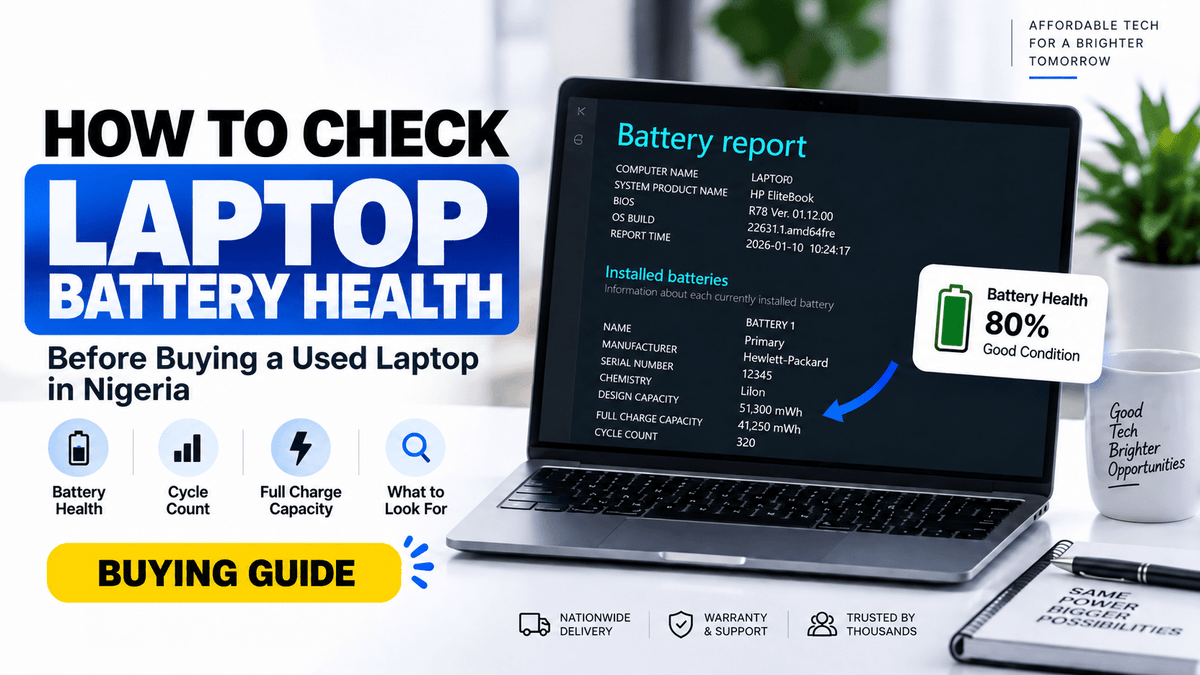
>> How to Check Laptop Battery Health Before Buying a Used Laptop in Nigeria
Quick Buying Guide: Core i5 or Core i7?
Student
Core i5 is usually sufficient.
Prioritize RAM, SSD, battery, and portability.
Small business owner
Core i5 is usually the better-value starting point.
Move to i7 if your applications genuinely require more computing power.
Office worker
Core i5 is typically enough.
Programmer
Core i5 or i7, depending on development workload.
Prioritize RAM heavily too.
Graphic designer
Core i5 or i7 can work.
Display, RAM, and graphics matter too.
Video editor
A performance-oriented Core i5 or Core i7, preferably alongside dedicated graphics depending on the editing workload.
Gamer
Don't decide using i5 vs i7 alone.
Check the GPU.
Engineer / CAD user
Higher-performance Core i7/workstation-class hardware may be more appropriate depending on your applications.
Frequently Asked Questions
Is Core i7 always better than Core i5?
No.
Within comparable processors from the same generation and class, the Core i7 tier is generally positioned higher. But a newer Core i5 can be a smarter purchase than a much older Core i7 depending on the specific processors and workload.
Is Core i5 good enough?
For many users, absolutely.
A modern Core i5 can comfortably handle productivity, school, business, browsing, programming, and many creative workloads when paired with sufficient RAM and SSD storage.
Should a student buy a Core i5 or a Core i7?
For most students, a good Core i5 provides an excellent balance of performance and price.
If the student's course involves demanding engineering, video production, 3D work, or other specialist software, stronger hardware may be justified.
Is Core i5 good for programming?
Yes.
Core i5 processors can handle web development, Python, application development, and many programming workloads.
Developers running virtual machines, heavy IDEs, or large projects may benefit from a Core i7 and additional RAM.
Is Core i7 good for gaming?
It can be, but the processor isn't enough.
A gaming laptop should also have a suitable dedicated GPU.
Which is better: 10th Gen Core i5 or 8th Gen Core i7?
There is no safe answer based only on those names.
You need the exact processor models, power class, and intended workload.
Intel's product comparisons show why this matters: even processors across different i5/i7 generations can overlap substantially in core/thread counts, cache, and frequency characteristics.
Which is better: a Core i5 with 16GB RAM or a Core i7 with 8GB RAM?
It depends on the processors and workload.
For heavy multitasking, the 16GB Core i5 configuration may sometimes give you a better practical experience.
For processor-heavy tasks, the Core i7 may be preferable.
Don't compare RAM and processor tier independently.
Is SSD more important than i5 vs i7?
They're solving different problems.
But for ordinary users moving from HDD to SSD, the difference in everyday responsiveness can be very noticeable.
Ideally, buy:
A suitable processor + enough RAM + SSD storage.
Final Verdict: Core i5 or Core i7?
Don't start your laptop search by saying:
“I want a Core i7.”
Start by saying:
“This is what I need the laptop to do.”
Then choose the specification that fits that job.
For most:
- Students
- Small-business owners
- Office workers
- Remote workers
- Everyday users
a well-configured Core i5 laptop can be more than enough.
Core i7 becomes increasingly worthwhile when your workload genuinely requires more performance.
But remember the most important lesson from this guide:
A processor is more than i5 or i7.
Check:
Generation + exact processor model + processor class + RAM + SSD + graphics + laptop condition.
That's how you choose the right laptop, not by chasing the biggest number on the sticker.
Shop Core i5 & Core i7 Laptops in Nigeria
Shopinverse currently carries Core i5 laptops across several generations, from affordable older business laptops to newer 10th to 13th-generation EliteBook, ThinkPad, and ZBook models.
For buyers who need more performance, the current high-performance range also includes Core i7 Dell Precision, HP ZBook, and Dell XPS configurations with dedicated NVIDIA graphics.

Share:
Best Laptops for Graphic Design & Video Editing in Nigeria