

 Laptops
 Phones & tablets
 Desktops
 Computer Parts
 Accessories
A laptop with 1TB storage is not automatically better than one with 256GB.
This is one of the most common mistakes people make when comparing laptops.
Imagine you're choosing between these two:
Laptop A
8GB RAM
256GB SSD
Laptop B
8GB RAM
1TB HDD
Both laptops have the same processor and RAM.
Laptop B gives you four times as much storage space.
So it must be better, right?
Not necessarily.
Laptop A may feel significantly faster during everyday use because it uses an SSD instead of a traditional mechanical hard drive.
This is because storage capacity and storage speed are two different things.
A bigger storage number doesn't automatically mean a faster or better laptop.
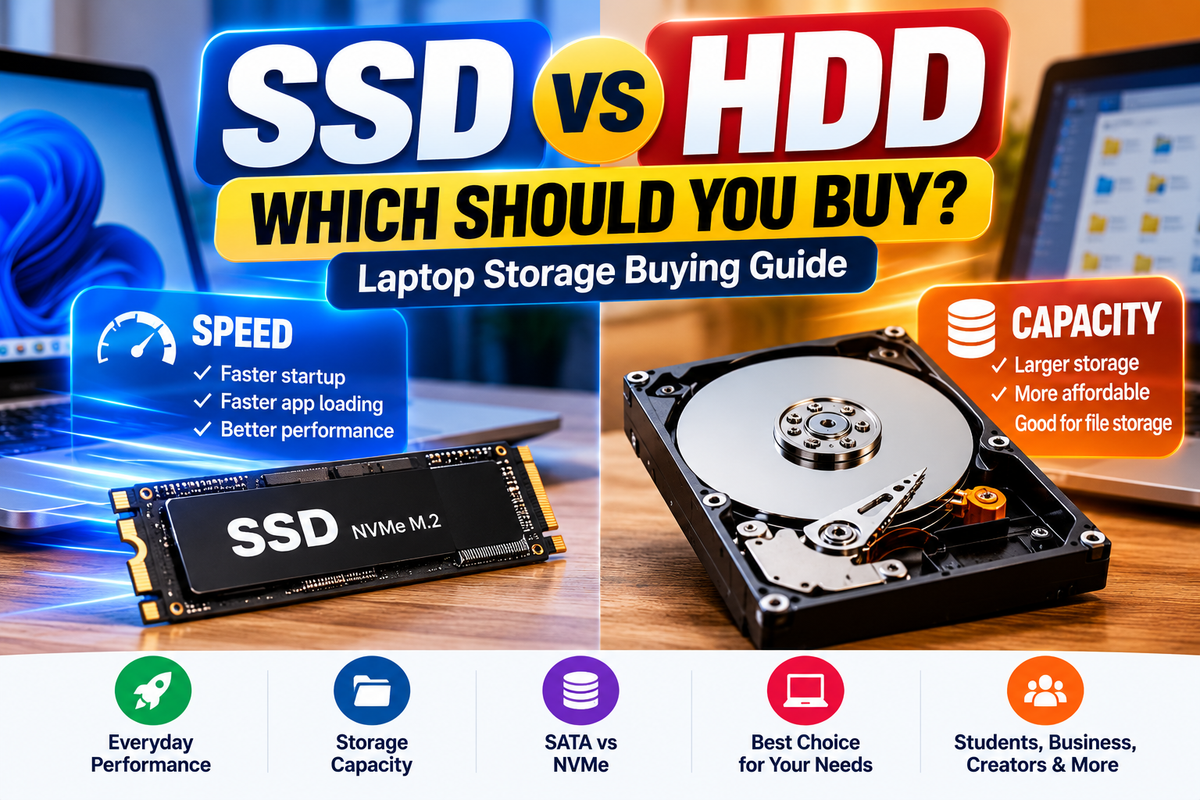
In this guide, we'll explain SSD vs HDD in simple terms, compare 256GB SSD with 1TB HDD, explain SATA and NVMe SSDs, and help you decide what type of storage is best for your laptop.
What Is Laptop Storage?
Before comparing SSD and HDD, let's clarify what storage actually does.
Your laptop's storage is where it permanently keeps things such as:
- Windows
- Applications
- Documents
- Photos
- Videos
- Music
- Games
- Downloaded files
When you turn the laptop off, these files remain on the storage drive.
This is different from RAM.
RAM temporarily holds data that applications are actively using, while the storage drive keeps your files and programs long term.
So a laptop with:
8GB RAM + 256GB SSD
has 8GB of working memory and 256GB of permanent storage.
If you want a deeper explanation of RAM, read:
8GB vs 16GB RAM: How Much RAM Do You Really Need? →
What Is an HDD?
HDD means Hard Disk Drive.
It is an older type of storage technology that uses mechanical components inside the drive.
Traditional hard drives contain spinning disks and a moving mechanism that reads and writes data.
HDDs have been used in computers for decades.
They remain useful because they can provide a large amount of storage at a relatively affordable cost.
Advantages of HDD Storage
- Large storage capacities can be affordable
- Useful for storing large quantities of files
- Can be suitable for movies, photos, archives, and backups
- Older laptops may already contain one
Disadvantages of HDD Storage
- Slower than modern SSD storage
- Uses mechanical moving parts
- Can make Windows feel less responsive
- Applications may take longer to open
- More sensitive to shock while operating
An HDD isn't automatically useless.
It simply serves a different purpose from an SSD.
What Is an SSD?
SSD means Solid State Drive.
Unlike a traditional HDD, an SSD does not rely on spinning disks and mechanical read/write heads.
It stores data electronically.
This allows SSDs to access data much faster than traditional hard drives in many everyday tasks.
Advantages of SSD Storage
- Faster Windows startup
- Applications generally open faster
- Files can load more quickly
- Better overall system responsiveness
- No spinning mechanical disk
- Normally quieter than an HDD
- Well suited to modern laptops
Disadvantages of SSD Storage
- Higher capacities can cost more
- A lower-budget SSD may provide less storage capacity than an HDD at the same price
- Not every SSD has the same performance
Shopinverse recommendation: For most people buying a Windows laptop today, SSD storage should be strongly preferred for the main operating-system drive.
SSD vs HDD: Which One Is Faster?
For everyday laptop use, SSD storage is generally much faster than HDD storage.
You may notice the difference when:
- Starting Windows
- Opening applications
- Searching for files
- Installing programs
- Copying files
- Loading large projects
- Performing Windows updates
This is why an older laptop can sometimes feel dramatically more responsive after replacing its HDD with an SSD.
The processor hasn't changed.
The RAM hasn't necessarily changed.
But the computer can access its operating system and applications more quickly.
256GB SSD vs 1TB HDD: Which Should You Choose?
This is probably the most important comparison for many laptop buyers.
Let's look at the trade-off.
| Feature | 256GB SSD | 1TB HDD |
|---|---|---|
| Storage space | Smaller | Much larger |
| System responsiveness | Generally faster | Generally slower |
| Moving parts | No | Yes |
| Best for | Windows, applications, everyday work | Large file storage and archives |
If your priority is:
Speed, faster startup and everyday responsiveness
I would generally choose the 256GB SSD.
If your priority is:
Storing a very large amount of videos, movies, photos, or other files at the lowest possible cost
a larger HDD may still be useful.
However, there is an even better option for many users.
SSD + HDD: Can You Have Both?
Yes.
Some laptops and desktops support two storage drives.
For example:
256GB SSD + 1TB HDD
This can give you the advantages of both technologies.
You can use the SSD for:
- Windows
- Applications
- Frequently used files
- Current projects
And use the HDD for:
- Large videos
- Photo archives
- Movies
- Backups
- Old project files
This setup is particularly useful for desktops and some larger laptops that support multiple drives.
For laptops that support only one internal drive, you can also combine an internal SSD with an external storage drive.
Is 128GB SSD Enough?
It can be enough for very basic use, but storage space may become restrictive quickly.
Windows, applications, and updates consume part of the drive.
Once you begin adding:
- Photos
- Videos
- Documents
- Offline files
- Large applications
128GB can start feeling small.
For a general-purpose laptop, I would prefer 256GB SSD or more where the budget allows.
For users who store large media files, 512GB or more can be significantly more comfortable.
Is 256GB SSD Enough?
For many students, office workers, small-business owners, and everyday users, yes.
256GB can comfortably handle:
- Windows
- Microsoft Office
- Browsers
- Business applications
- School documents
- Moderate personal files
But it may become restrictive for:
- Large video libraries
- Professional photography
- Modern games
- Large design projects
- Video editing
If you're buying a laptop for those activities, consider 512GB or 1TB storage.
256GB vs 512GB SSD: Which Is Better?
Both provide the benefits of SSD storage.
The main difference for most buyers is capacity.
Choose 256GB SSD if:
- You mainly use cloud storage
- Your files are relatively small
- You primarily browse and use office applications
- Your budget is limited
Choose 512GB SSD if:
- You keep more files locally
- You work with photos or videos
- You install many applications
- You want more breathing room
- You plan to use the laptop for several years
For many professionals, 512GB is an excellent balance between capacity and convenience.
What About 1TB SSD?
A 1TB SSD gives you both large capacity and the responsiveness of solid-state storage.
It can be particularly attractive for:
- Video editors
- Photographers
- Gamers
- Content creators
- Engineers
- Professionals handling large project files
However, there is no reason to pay for 1TB if your current and expected storage needs are far smaller.
Buy based on your actual workload.
SATA SSD vs NVMe SSD: What's the Difference?
Not all SSDs are the same.
Two common types you'll encounter are:
SATA SSD
SATA SSDs are commonly available in a 2.5-inch form factor and are often used to upgrade laptops that originally came with a traditional 2.5-inch HDD.
They can provide a major improvement over mechanical storage.
NVMe SSD
NVMe SSDs commonly use an M.2 form factor and communicate through a faster PCIe interface.
They are common in newer laptops and can offer substantially higher data-transfer performance than SATA drives.
Important: Don't buy an SSD simply because it physically looks like it will fit. Your laptop must support the drive's specific form factor and interface.
Which Is Better for Students: SSD or HDD?
For most students, I recommend SSD storage.
Students frequently need their laptops to:
- Start quickly before lectures
- Open assignments
- Run Microsoft Office
- Browse research materials
- Join online classes
- Switch between applications
A laptop with 8GB RAM and a 256GB SSD can be a very practical student configuration.
If you need large storage for videos or course materials, you can add external storage later.
Which Is Better for Small Business Owners?
For most small-business owners, SSD is again the better choice for the main drive.
Imagine using your laptop every day for:
- Excel
- Inventory
- Invoices
- Online banking
- WhatsApp Web
- Customer records
You probably value responsiveness more than having several terabytes of internal storage.
An SSD-based laptop can make daily business tasks feel more efficient.
If your business stores large quantities of CCTV footage, photos, or videos, use additional storage for those large files.
Which Is Better for Programming?
For programmers, SSD is strongly preferable.
Programming workflows can involve:
- Development environments
- Large numbers of small files
- Package installations
- Compiling projects
- Databases
- Virtual machines
Storage performance can affect how responsive these workflows feel.
I would start with at least 256GB SSD for lighter development.
512GB or more becomes attractive if you use virtual machines, large development environments, or keep many projects locally.
Which Is Better for Graphic Design and Video Editing?
Creators should generally prioritize SSD storage.
Photo and video applications regularly load large files and create temporary working data.
For serious creative work, I would prefer:
512GB SSD or larger for the operating system, applications, and active projects, combined with additional storage for archives where necessary.
Remember that storage alone doesn't determine editing performance.
Processor, RAM, and GPU also matter.
Read: Best Laptops for Graphic Design & Video Editing in Nigeria →
Which Is Better for Gaming?
Modern games can consume a large amount of storage.
An SSD is useful because it can improve loading times and general responsiveness.
However, 256GB may not provide enough space if you install several large games.
Gaming buyers should consider:
512GB SSD or 1TB SSD
depending on their library and budget.
You should also prioritize the processor and dedicated GPU.
Can You Upgrade an Old Laptop From HDD to SSD?
In many cases, yes.
This can be one of the most effective upgrades for an older laptop that still uses a mechanical hard drive.
If the laptop uses a standard 2.5-inch SATA hard drive, it may support a compatible 2.5-inch SATA SSD.
However, compatibility should always be confirmed for the exact laptop model before purchasing.
You should check:
- Drive size and form factor
- SATA or NVMe support
- Available M.2 slot
- Drive thickness where relevant
- Maximum supported configuration
Need an SSD Upgrade?
Shopinverse carries laptop and desktop SSD options in different formats and capacities.
How to Check Whether Your Laptop Has SSD or HDD
You can check this directly in Windows.
Method 1: Task Manager
Right-click your taskbar and open:
Select the disk.
Windows may identify it as:
SSD
or
HDD
Method 2: Optimize Drives
Search Windows for:
Look under Media type.
Windows may identify the drive as a solid-state drive or hard disk drive.
If you're purchasing a used laptop, verify the storage specification rather than relying only on the seller's description.
How Much Storage Do You Actually Need?
| Storage | Best suited for |
|---|---|
| 128GB SSD | Very basic computing and cloud-based use |
| 256GB SSD | Students, office work, business and everyday computing |
| 512GB SSD | Professionals, programmers, creators and heavier applications |
| 1TB SSD | Video editors, gamers and users storing many large files |
| 1TB HDD | Large archives, movies, photos and inexpensive bulk storage |
These aren't strict rules.
Your actual storage requirement depends on your files and applications.
Does SSD Increase RAM?
No.
SSD and RAM are different components.
Upgrading from HDD to SSD does not turn:
8GB RAM into 16GB RAM.
Likewise, increasing RAM does not increase your permanent file-storage capacity.
They improve different parts of your computer experience.
This is why a balanced laptop matters.
Does SSD Make a Core i5 Faster Than a Core i7?
This question needs careful wording.
An SSD does not change the processor itself.
A Core i5 doesn't become a Core i7 because you install an SSD.
However, the SSD can make the entire laptop feel more responsive during tasks that depend heavily on storage.
That means an SSD-based Core i5 laptop may feel faster during startup and everyday application loading than an HDD-based Core i7 laptop.
But CPU-intensive applications may still favour the stronger processor.
Always compare the complete specifications.
Read: Core i5 vs Core i7 – Which Laptop Should You Buy? →
SSD vs HDD When Buying a Used Laptop
If you're buying a pre-owned laptop, don't assume that every machine has an SSD.
Older business laptops may still come with:
- 250GB HDD
- 320GB HDD
- 500GB HDD
Newer configurations are much more likely to use SSD storage.
Before buying, check:
- Storage type
- Storage capacity
- Available free space
- Drive condition
- Whether the drive is upgradeable
If you're considering a used laptop, also read:
How to Check a Used Laptop Before Buying in Nigeria →
What About eMMC Storage?
You may also see affordable laptops and Chromebooks advertised with:
32GB eMMC
64GB eMMC
128GB eMMC
eMMC is another type of flash storage commonly used in lower-cost and compact devices.
It has no mechanical moving parts like an HDD, but it is generally not equivalent to the replaceable SSD storage found in many mainstream laptops.
eMMC can be appropriate for:
- Chromebooks
- Basic browsing
- Schoolwork
- Cloud-based computing
But buyers who install many applications or store large amounts of data locally may prefer an SSD-based laptop.
SSD vs HDD: Quick Buying Guide
Choose SSD if you want:
✓ Faster Windows startup
✓ Faster application loading
✓ Better everyday responsiveness
✓ A modern laptop experience
✓ Storage for your main operating system
Choose HDD if you mainly need:
✓ Large inexpensive storage
✓ File archives
✓ Movies and media libraries
✓ Backup storage
Best of both worlds: SSD for Windows and applications + HDD or external storage for large files.
Frequently Asked Questions
Which is better: SSD or HDD?
For most modern laptop users, SSD is the better choice for the main drive because of its faster responsiveness.
HDD remains useful when inexpensive high-capacity storage is the main priority.
Is 256GB SSD better than 1TB HDD?
For system responsiveness and everyday use, 256GB SSD is usually preferable.
For sheer storage capacity, the 1TB HDD provides much more space.
Your priority determines the better choice.
Does SSD make a laptop faster?
An SSD can significantly improve storage-related performance such as Windows startup, application loading, and file access.
It does not make the processor or graphics card more powerful.
Is 256GB SSD enough for a student?
For many students, yes.
It is usually sufficient for Windows, Office applications, research, assignments, and moderate personal files.
Is 512GB SSD enough for video editing?
It can be a good starting point for active projects, but video files consume storage quickly.
Professional editors may need larger internal storage or additional external drives.
Can I replace HDD with SSD?
Many laptops that use a standard SATA HDD can be upgraded to a compatible SATA SSD.
Compatibility should be confirmed for the exact laptop model.
Is NVMe better than SATA SSD?
NVMe SSDs can provide higher transfer performance than SATA SSDs.
However, both can provide a significantly better everyday experience than a traditional HDD.
Does SSD improve gaming FPS?
An SSD generally improves loading and storage responsiveness rather than directly increasing the graphics-processing power that determines most game frame rates.
Should I buy an HDD laptop if it is cheaper?
It can make sense if your budget is very limited and the rest of the laptop suits your needs.
However, check whether the drive can be upgraded to SSD later.
Is 1TB storage always better than 256GB?
No.
1TB describes capacity, not necessarily speed.
A 256GB SSD and 1TB HDD have very different characteristics.
Final Verdict: SSD or HDD?
If you're buying a laptop for:
- School
- Office work
- Business
- Programming
- Remote work
- Graphic design
- Everyday personal use
I would generally prioritize SSD storage.
For most buyers, even a 256GB SSD can provide a better everyday experience than a much larger HDD when speed and responsiveness matter.
HDD still has value when your priority is storing large amounts of data inexpensively.
And when possible, combining:
SSD for speed + additional storage for capacity
can give you the best of both worlds.
Most importantly, don't buy a laptop simply because the storage number looks bigger.
Ask:
Is it SSD or HDD?
How much storage do I actually need?
Can I upgrade it later?
Those questions will help you make a much smarter buying decision.
Looking for an SSD Laptop?
Browse Shopinverse laptops across different storage capacities, processors, and budgets.
Compare the full specifications before choosing the option that fits your work.


Share: