

 Laptops
 Phones & tablets
 Desktops
 Computer Parts
 Accessories
Don't buy a laptop simply because someone told you, "Core i5 is good."
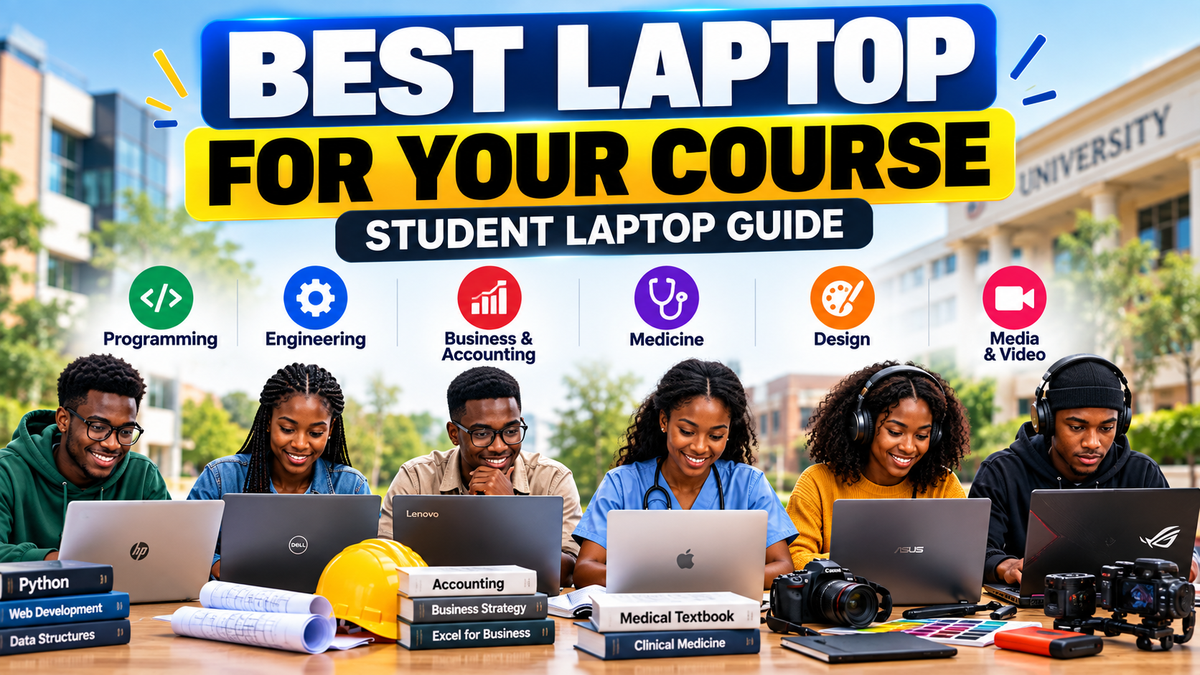
The right laptop for a university student depends heavily on what the student is actually studying.
Consider two students with exactly the same budget.
One studies Accounting.
The other studies Architecture.
Should they automatically buy the same laptop?
Probably not.
The Accounting student may spend most of the time using:
- Microsoft Excel
- Word
- PowerPoint
- Browsers
- Accounting software
- PDF documents
The Architecture student may need:
- AutoCAD
- Revit
- 3D modeling software
- Rendering applications
- Large project files
Those are very different workloads.
The best student laptop isn't necessarily the most expensive laptop. It's the laptop with the right specifications for your course.
In this guide, we'll explain what students in different university courses should look for, how much RAM and storage they actually need, when dedicated graphics matter, and which specifications are worth paying extra for.
First: What Specifications Should Every Student Check?
Before looking at individual courses, there are six important specifications every student should understand.
1. Processor
The processor affects how quickly the laptop performs calculations and handles applications.
You may see processors such as:
- Intel Core i3
- Intel Core i5
- Intel Core i7
- AMD Ryzen 3
- AMD Ryzen 5
- AMD Ryzen 7
But don't look at the Core i5 or Core i7 name alone.
The processor generation and exact model also matter.
A suitable newer Core i5 can sometimes be a smarter purchase than a much older Core i7.
Read: Core i5 vs Core i7 – Which Laptop Should You Buy? →
2. RAM
RAM affects how comfortably your laptop can keep several applications and files active at the same time.
For many students:
8GB RAM is a practical starting point.
16GB RAM is preferable for programming, engineering, graphics, heavier multitasking, and professional applications.
32GB RAM becomes relevant for some advanced engineering, 3D, virtual-machine, and high-resolution video workflows.
Read: 8GB vs 16GB RAM – How Much RAM Do You Really Need? →
3. Storage
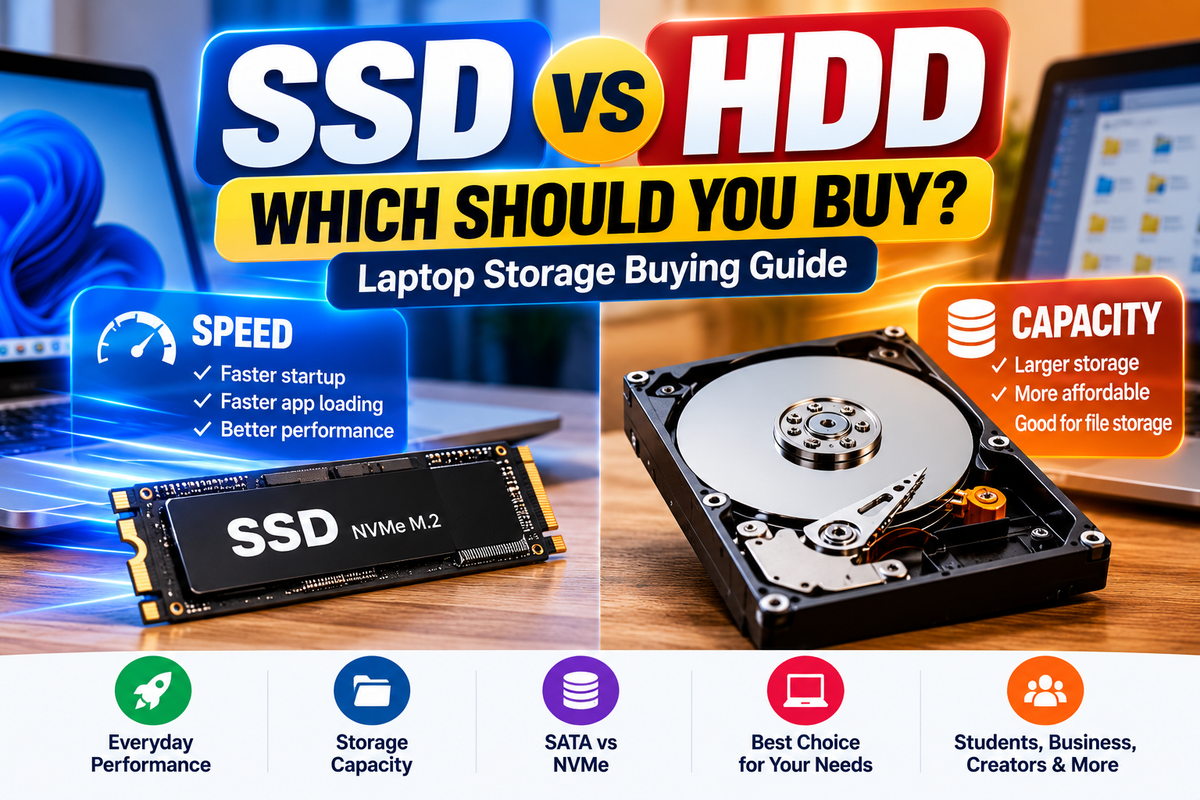
For most students, I strongly recommend an SSD rather than a traditional HDD as the main drive.
A useful starting point is:
256GB SSD for normal schoolwork.
512GB SSD for programming, engineering, design, media, and students who store many files locally.
Read: SSD vs HDD – Which Should You Buy? →
4. Graphics
Many students do not need a dedicated graphics card.
Integrated Intel or AMD graphics can be perfectly suitable for:
- Microsoft Office
- Browsing
- Research
- Programming
- Accounting
- Online classes
- General university work
Dedicated NVIDIA or AMD graphics become more important for workloads such as:
- 3D modelling
- CAD
- Rendering
- Video editing
- Animation
- Some engineering applications
5. Display
For most students, a Full HD 1920 × 1080 display is a good target where the budget allows.
Screen size also matters.
13.3-inch: Excellent for portability.
14-inch: A very good balance between portability and workspace.
15.6-inch: Better for students who value screen space over portability.
6. Battery and Portability
If you're carrying your laptop between lectures, library sessions, hostels, and group meetings, size and battery condition matter.
A powerful 17-inch workstation may be excellent at rendering but uncomfortable to carry around campus every day.
Choose based on how you will actually use the laptop.
Quick Guide: Recommended Laptop Specs by Course
| Course / Use | Processor | RAM | Storage | Graphics |
|---|---|---|---|---|
| Law, Arts & Social Sciences | Core i3/i5 or Ryzen 3/5 | 8GB | 256GB SSD | Integrated |
| Accounting & Business | Core i5 / Ryzen 5 | 8–16GB | 256–512GB SSD | Integrated |
| Computer Science & Programming | Core i5 / Ryzen 5 or better | 16GB preferred | 512GB SSD preferred | Integrated usually sufficient |
| Engineering & Architecture | Performance Core i5/i7 or Ryzen 5/7 | 16GB minimum target; 32GB for heavier work | 512GB SSD+ | Dedicated GPU recommended for 3D/CAD |
| Graphic Design | Core i5/i7 or Ryzen 5/7 | 16GB | 512GB SSD | Dedicated graphics helpful |
| Video / Film / Media Production | Performance Core i5/i7 or Ryzen 5/7+ | 16GB HD / 32GB+ heavier 4K | 512GB SSD+ | Dedicated GPU strongly recommended |
| Medicine & Health Sciences | Core i5 / Ryzen 5 | 8–16GB | 256–512GB SSD | Integrated |
These are practical buying targets, not universal software requirements. Always check the requirements of the specific applications your department uses.
Best Laptop Specifications for Law, Arts, Education & Social Science Students
Students studying subjects such as:
- Law
- English
- History
- Political Science
- Sociology
- Education
- International Relations
- Mass Communication without heavy editing workloads
usually spend much of their computing time working with:
- Word processing
- PDF documents
- Research
- PowerPoint
- Web browsers
- Online classes
You generally do not need an expensive graphics workstation for this type of workload.
Recommended Specification
Processor: Core i3/Core i5 or Ryzen 3/Ryzen 5
RAM: 8GB
Storage: 256GB SSD
Display: 13.3-inch or 14-inch Full HD where possible
Graphics: Integrated graphics
For this category of student, I'd prioritize portability, battery condition and a comfortable keyboard over dedicated graphics.
Best Laptop for Accounting, Economics & Business Students
Business-related students often use:
- Microsoft Excel
- Word
- PowerPoint
- Accounting packages
- Browsers
- Statistical applications
- Online meetings
A good business-class Core i5 or Ryzen 5 laptop is an excellent fit for many of these students.
Recommended Specification
Processor: Core i5 or Ryzen 5
RAM: 8GB minimum practical target; 16GB for heavier multitasking
Storage: 256GB SSD minimum; 512GB if budget permits
Display: 14-inch Full HD
Graphics: Integrated graphics are normally sufficient
For Excel-heavy work, screen space can also be useful.
If you don't carry the laptop around frequently, a 15.6-inch model may provide a more comfortable spreadsheet experience.
Best Laptop for Computer Science & Programming Students
Programming requirements vary significantly.
A first-year student learning:
- HTML
- CSS
- JavaScript
- Python
- Basic Java
doesn't necessarily need an expensive workstation.
But programming workloads can become heavier once you start using:
- Android Studio
- Docker
- Virtual machines
- Databases
- Large IDEs
- Multiple development environments
Recommended Specification
Processor: Core i5 / Ryzen 5 or better
RAM: 16GB preferred
Storage: 512GB SSD preferred
Display: 14-inch or 15.6-inch Full HD
Graphics: Integrated graphics are sufficient for most programming students
If you expect to run several virtual machines or memory-intensive development tools, 32GB RAM can become worthwhile.
But most undergraduate programmers should prioritize:
Good processor + 16GB RAM + SSD storage
before worrying about an expensive dedicated GPU.
Browse Laptops for Programming →
Best Laptop for Engineering Students
This category requires more careful planning.
Engineering students may use software for:
- CAD
- Simulation
- 3D modelling
- Programming
- Engineering calculations
- Technical drawing
Applications such as AutoCAD can demand significantly more hardware than Word or Excel.
Autodesk's current AutoCAD requirements list 8GB RAM as a basic requirement and 32GB as recommended for Windows, alongside stronger graphics recommendations for more demanding workloads.
View AutoCAD system requirements →
Recommended Engineering Student Specification
Processor: Performance-oriented Core i5/Core i7 or Ryzen 5/Ryzen 7
RAM: 16GB starting target
Storage: 512GB SSD+
Display: Full HD
Graphics: Dedicated NVIDIA/AMD graphics strongly recommended for substantial 3D and CAD workloads
Students doing heavy 3D work, large AutoCAD projects, simulation, or rendering should consider 32GB RAM and stronger workstation-class graphics where their software benefits from it.
Browse Laptops for Engineering →
Best Laptop for Architecture Students
Architecture students frequently have some of the heaviest laptop requirements on campus.
Your software may include:
- AutoCAD
- Revit
- SketchUp
- 3D modeling tools
- Rendering software
- Adobe applications
A thin office laptop may work perfectly for Word and browsing but struggle badly with complex architectural workloads.
Recommended Architecture Student Specification
Processor: Core i7 / Ryzen 7 or strong performance-class Core i5/Ryzen 5
RAM: 16GB minimum practical target; 32GB preferable for heavier projects
Storage: 512GB SSD or larger
Display: 15-inch-class Full HD or better
Graphics: Dedicated GPU
A workstation-class laptop may be worth considering if the budget permits.
Best Laptop for Graphic Design Students
Graphic-design students need to think beyond processor speed.
Your display is also important because you're actually making visual decisions on it.
Common applications include:
- Adobe Photoshop
- Illustrator
- Lightroom
- Canva
- Figma
Recommended Specification
Processor: Core i5/i7 or Ryzen 5/7
RAM: 16GB preferred
Storage: 512GB SSD
Display: Full HD with good color reproduction
Graphics: Dedicated GPU helpful for heavier workflows
For basic Canva and lighter design work, a modern laptop with integrated graphics can still be perfectly usable.
Don't pay for a high-end graphics card if your actual workload doesn't require it.
Browse Laptops for Graphic Design →
Best Laptop for Video Editing, Film & Media Students
Video editing can be substantially more demanding than ordinary student work.
Applications may include:
- Adobe Premiere
- DaVinci Resolve
- After Effects
- CapCut
- Other editing applications
Adobe currently recommends 16GB RAM for HD Premiere workflows and 32GB or more for 4K and higher-resolution media.
View Adobe Premiere system requirements →
Recommended Specification
Processor: Performance Core i5/i7 or Ryzen 5/7+
RAM: 16GB for regular HD editing; 32GB+ for heavier 4K workflows
Storage: 512GB SSD minimum practical target
Display: Full HD or better
Graphics: Dedicated NVIDIA/AMD GPU
For video editing, don't judge a laptop only by RAM.
GPU capability, processor performance, cooling, and SSD storage all matter.
Browse Laptops for Video Editing →
Best Laptop for Medicine & Health Science Students
Medical students often spend a lot of time using:
- PDF textbooks
- Lecture slides
- Research websites
- Video lectures
- Note-taking applications
- Online learning platforms
That means portability and battery condition can be more important than having a dedicated GPU.
Recommended Specification
Processor: Core i5 / Ryzen 5
RAM: 8GB minimum practical target; 16GB for extra headroom
Storage: 256GB or 512GB SSD
Display: 13.3-inch or 14-inch Full HD
Graphics: Integrated
I would prioritize a lighter machine with a good keyboard and battery condition over a large gaming laptop unless your department specifically requires specialist software.
What About Mass Communication Students?
This depends on what part of the course you focus on.
If most of your work involves:
- Writing
- Research
- Presentations
- Social media
- Canva
a good Core i5 laptop with 8–16GB RAM and SSD storage should be adequate.
But if you regularly edit:
- Video documentaries
- Interviews
- Short films
- Motion graphics
follow the video-editing recommendations instead.
The name of your course matters less than the software you actually use.
Do Students Need Core i7?
No.
Core i7 is not a universal requirement for university.
A good Core i5 can be an excellent choice for:
- Business students
- Law students
- Medical students
- Programming students
- General academic work
Core i7 becomes more useful as the workload becomes increasingly processor-intensive.
But don't buy:
an old Core i7 with poor storage and insufficient RAM
simply because Core i7 sounds more powerful.
Always evaluate the complete laptop.
Is 8GB RAM Enough for University?
For many students, yes.
8GB can comfortably handle:
- Word
- PowerPoint
- PDFs
- Research
- Online classes
- Moderate browser multitasking
However, 16GB is increasingly worthwhile for:
- Programming
- Graphics
- Engineering
- Video editing
- Heavy multitasking
Microsoft's Windows 11 minimum is 4GB RAM, but minimum requirements are not the same thing as a comfortable student recommendation.
View Windows 11 requirements →
Should Students Choose 256GB or 512GB SSD?
For normal university work:
256GB SSD can be sufficient.
For programming, engineering, graphic design or media:
512GB SSD provides considerably more breathing room.
Large software packages and project files can consume storage quickly.
External SSDs and cloud storage can also be used where appropriate.
13.3-inch vs 14-inch vs 15.6-inch for Students
13.3-inch
Choose this if portability is your priority.
It is easier to carry between lectures and generally fits smaller bags.
14-inch
This is my favorite all-round size for many university students.
It provides a useful balance between screen space and portability.
15.6-inch
Choose this if screen space matters more than portability.
It is particularly useful for:
- Engineering
- Architecture
- Video editing
- Large spreadsheets
- Creative work
Should a Student Buy a Touchscreen Laptop?
A touchscreen can be useful for:
- Drawing
- Handwritten notes
- Presentations
- 2-in-1 tablet use
- Annotation
But it isn't essential for every student.
If choosing a touchscreen means sacrificing RAM, SSD capacity, or a better processor within a limited budget, consider which feature actually contributes more to your studies.
Can a Chromebook Be Good for University?
Yes—for the right student.
A Chromebook can be practical for:
- Browsing
- Google Docs
- Online classes
- Cloud-based assignments
- Basic research
However, a Chromebook is not automatically a replacement for a Windows laptop.
If your course requires specific Windows-only engineering, programming, accounting, or professional applications, confirm compatibility before buying.
Brand-New Laptop vs USA-Used Laptop for Students
This depends on your budget and priorities.
A brand-new laptop can offer advantages such as:
- New battery
- Manufacturer packaging
- Newer entry-level hardware
A professionally tested pre-owned business laptop may give you access to:
- Higher-grade build quality
- Better keyboard
- More RAM
- SSD storage
- Business features
for a similar budget.
Neither option is automatically better.
Compare:
- Processor
- RAM
- SSD
- Battery condition
- Display
- Physical condition
- Warranty
If you're considering a pre-owned laptop, read:
How to Check a Used Laptop Before Buying in Nigeria →
What Students Should NOT Pay Extra For
This is where you can save money.
1. Core i7 when Core i5 already meets your needs
A Law student doesn't automatically need Core i7.
2. Dedicated NVIDIA graphics for basic schoolwork
If you mostly use Word, Excel, and browsers, you may never benefit from it.
3. 32GB RAM for simple assignments
More RAM is useful only when your workload needs it.
4. 1TB internal SSD when you barely store files
256GB or 512GB may be more sensible.
5. Touchscreen just because it looks premium
Buy it when it contributes to your workflow.
Spend your money on the specifications that affect your actual coursework—not the features that simply look impressive in an advert.
What Students SHOULD Prioritize
For most university buyers, prioritize these in order:
- The correct processor for your workload
- Enough RAM
- SSD storage
- A suitable display
- Battery condition
- Portability
- Warranty and after-sales support
A balanced laptop is more useful than one impressive specification surrounded by weak components.
Frequently Asked Questions
What is the best laptop specification for a university student?
For general university use, a Core i5/Ryzen 5 laptop with 8GB RAM and 256GB SSD is a strong starting point.
More demanding courses may require 16GB RAM, 512GB SSD and dedicated graphics.
Is Core i5 enough for students?
Yes, for most students.
Core i5 can handle typical academic productivity, business software, programming, and many creative tasks, depending on the processor generation and complete configuration.
Is 8GB RAM enough for university?
Yes, for ordinary assignments, Office applications, and research.
16GB is preferable for programming, engineering, design, and heavy multitasking.
Do engineering students need dedicated graphics?
Students doing substantial 3D modeling rendering, and GPU-dependent CAD work should strongly consider dedicated graphics.
Check the requirements of the actual software used by your department.
Does a programming student need a graphics card?
Not usually for normal software development.
Machine learning, game development, 3D programming, and certain specialist workloads may benefit from dedicated graphics.
Is 256GB SSD enough for students?
For many students, yes.
512GB is preferable for courses involving large applications and project files.
Which laptop screen size is best for students?
14 inches provides one of the best balances between portability and workspace.
15.6 inches can be preferable for engineering and creative work.
Should students buy used laptops?
A properly tested pre-owned laptop can offer excellent value when its specifications, condition, and warranty suit the buyer's needs.
Can Chromebook work for university?
Yes, for browser-based coursework and cloud applications, but confirm compatibility if your course requires Windows or specialist software.
Final Verdict: Buy for Your Course, Not for the Sticker
There is no single "best laptop for every university student."
The student studying:
Law
doesn't necessarily need the same hardware as someone studying:
Architecture.
And a Computer Science student doesn't necessarily need the same laptop as someone studying Medicine.
Before buying, ask yourself:
- What applications will I use?
- How much RAM do they need?
- Do I need dedicated graphics?
- How much storage will my projects consume?
- Will I carry this laptop around every day?
- Can the RAM or SSD be upgraded later?
Then choose accordingly.
Your course should determine your laptop—not somebody else's specifications.
Find a Laptop for Your Course
Shopinverse has dedicated laptop collections for students, programmers, engineers, graphic designers, video editors, and other users.
Choose the category closest to your workload and compare the available specifications.

Share: