

 Laptops
 Phones & tablets
 Desktops
 Computer Parts
 Accessories
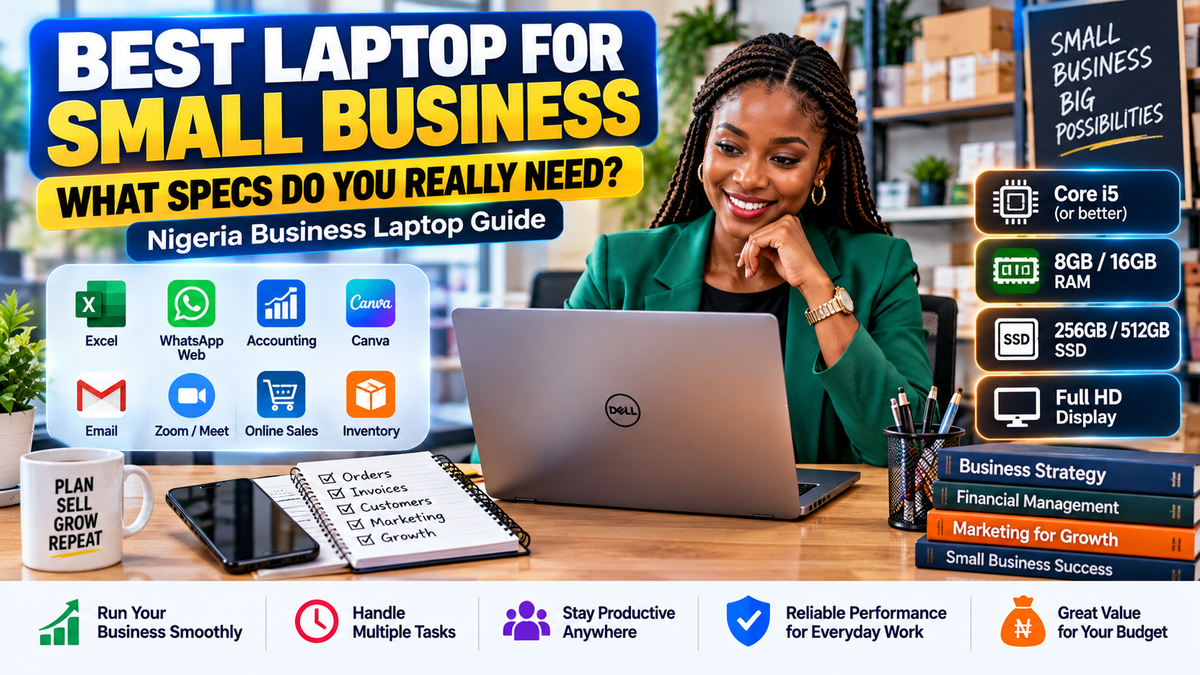
If your laptop is your office, buying the wrong one can cost your business much more than the price of the laptop.
Think about how many things a small-business owner may do on one computer every day.
- Reply to customers on WhatsApp Web
- Send emails
- Prepare invoices
- Update Excel spreadsheets
- Manage inventory
- Use accounting software
- Design flyers on Canva
- Attend Zoom or Google Meet calls
- Manage social media accounts
- Process online orders
- Browse supplier websites
That laptop is no longer just a computer.
It has become part of your business infrastructure.
But that doesn't mean every small-business owner needs an expensive Core i7 workstation with 32GB RAM and dedicated NVIDIA graphics.
At the same time, buying the cheapest laptop available simply because it turns on can create unnecessary frustration.
The best business laptop is not necessarily the most powerful laptop. It is the laptop that comfortably handles your daily work without making you pay for performance you may never use.
In this guide, we'll explain what processor, RAM, storage, display, and other features small-business owners should look for, and how to choose the right laptop for different types of businesses in Nigeria.
What Does a Small Business Owner Actually Need a Laptop For?
Before discussing specifications, start with your daily workload.
A small retail shop owner may mainly use:
- Excel
- Inventory software
- WhatsApp Web
- Online banking
- Web browsers
A digital marketer might use:
- Canva
- Meta Business Suite
- Google Ads
- Analytics
- Many browser tabs
- Video meetings
A photographer or content creator may need:
- Photoshop
- Lightroom
- CapCut
- Premiere Pro
- Large image and video files
Those are very different workloads.
This is why the question should not simply be:
"Should I buy Core i5 or Core i7?"
A better question is:
"What applications does my business use, and what specification will run them comfortably?"
Quick Guide: Recommended Business Laptop Specifications
| Business Type | Processor | RAM | Storage | Graphics |
|---|---|---|---|---|
| Retail / Shop Owner | Core i5 / Ryzen 5 | 8GB | 256GB SSD | Integrated |
| Accounting / Office Work | Core i5 / Ryzen 5 | 8–16GB | 256–512GB SSD | Integrated |
| Online Seller / E-commerce | Core i5 / Ryzen 5 | 16GB preferred | 256–512GB SSD | Integrated |
| Remote Worker / Consultant | Core i5 / Ryzen 5 or better | 16GB preferred | 512GB SSD | Integrated usually sufficient |
| Digital Marketing / Social Media | Core i5 / Ryzen 5+ | 16GB | 512GB SSD preferred | Integrated or entry dedicated GPU |
| Content / Creative Business | Performance Core i5/i7 or Ryzen 5/7+ | 16–32GB | 512GB SSD+ | Dedicated GPU recommended for heavier work |
These are practical buying targets, not strict rules. Your actual software and workload should determine the final specification.
1. Which Processor Does a Business Laptop Need?
The processor is important, but don't choose your laptop based only on the words:
Core i5
or
Core i7.
Processor generation and exact model matter too.
For many small-business owners, a reasonably modern Core i5 or Ryzen 5 gives an excellent balance of:
- Performance
- Battery efficiency
- Price
- Multitasking capability
A Core i5 can comfortably handle many business applications, including:
- Excel
- Word
- Browsers
- Accounting software
- Inventory systems
- Online meetings
- Canva
When should a business owner consider Core i7?
A stronger Core i7 or equivalent processor becomes more useful when your work involves:
- Heavy video editing
- Large data workloads
- Engineering software
- Professional content creation
- Virtual machines
- Large development environments
- Very demanding multitasking
Don't pay extra for Core i7 simply because the number sounds better. Spend that money where it improves your actual workflow.
Read: Core i5 vs Core i7 – Which Laptop Should You Buy? →
2. Is 8GB RAM Enough for Business?
For many straightforward business tasks, yes.
An 8GB laptop can be perfectly suitable if you mainly use:
- Excel
- Word
- WhatsApp Web
- A few browser tabs
- Accounting software
- Inventory applications
However, small-business owners often multitask heavily without realizing it.
You may have:
- 20 Chrome tabs open
- WhatsApp Web running
- Excel open
- Canva open
- Email running
- A Zoom call active
At that point, 16GB RAM can provide much more breathing room.
Practical recommendation: Choose 8GB for straightforward business work. Choose 16GB if you regularly run many applications and browser tabs simultaneously.
Read: 8GB vs 16GB RAM – How Much RAM Do You Really Need? →
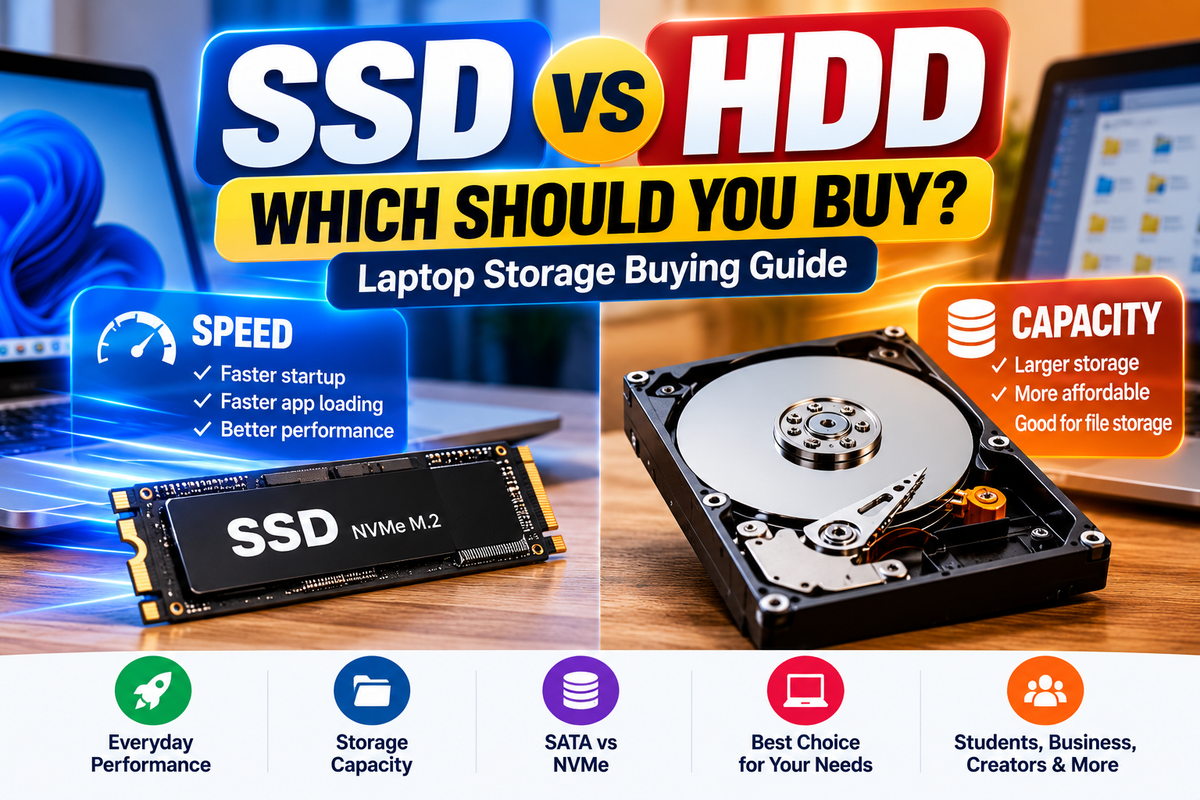
3. SSD or HDD for a Business Laptop?
For most small businesses, I strongly recommend an SSD as the main storage drive.
An SSD can improve:
- Windows startup
- Application loading
- File access
- General responsiveness
This matters in business because waiting for a slow computer repeatedly throughout the day wastes time.
How much SSD storage do you need?
256GB SSD: Suitable for many office and business users.
512GB SSD: Better if you store more files locally or use larger applications.
1TB SSD: Useful for content businesses, photographers, video editors or companies storing large project files.
A traditional HDD can still be useful for inexpensive bulk storage, but I would generally avoid using one as the main Windows drive if an SSD option is available within your budget.
Read: SSD vs HDD – Which Should You Buy? →
4. What Screen Size Is Best for Business?
There is no universal answer.
13.3-inch
Best for entrepreneurs who move around frequently.
It is easier to carry to:
- Meetings
- Client visits
- Co-working spaces
- Business trips
14-inch
This is one of the best all-round sizes for business users.
It provides a good balance of:
- Screen space
- Portability
- Weight
15.6-inch
This can be better for:
- Large spreadsheets
- Accounting
- Design
- Working mainly at a desk
If your laptop rarely leaves your office, the larger display may be more comfortable.
5. Full HD Display: Is It Worth It for Business?
Where your budget allows, I recommend a Full HD display with a resolution of:
1920 × 1080
A Full HD screen gives you more usable workspace than many older low-resolution panels.
That is especially useful when working with:
- Spreadsheets
- Multiple windows
- Dashboards
- Web applications
- Documents
For ordinary office work, you do not necessarily need an expensive 4K display.
6. Battery Life Matters More Than Many Business Owners Think
Imagine you're preparing an important invoice during a power interruption.
Or you're attending a client meeting away from your normal office.
That is when battery performance becomes important.
Battery requirements depend heavily on how mobile you are.
If you work mainly at a desk
Battery condition still matters, but you may not need extremely long unplugged runtime.
If you're frequently mobile
Prioritize:
- Battery condition
- Smaller size
- Lower weight
- Efficient processor
When buying a pre-owned laptop, don't rely only on a seller telling you:
"Battery lasts five hours."
Battery runtime varies depending on workload and brightness.
Read: How to Check Laptop Battery Health Before Buying →
7. Don't Ignore the Keyboard
If you run a business, you may type thousands of words every week.
That includes:
- Emails
- Invoices
- Customer replies
- Reports
- Proposals
- Social media captions
A comfortable keyboard can therefore matter more than flashy specifications.
Business-class laptop families such as:
- HP EliteBook
- Dell Latitude
- Lenovo ThinkPad
are commonly designed around office and professional productivity.
When comparing laptops, check:
- Keyboard condition
- Key travel
- Backlit keyboard availability
- Keyboard layout
A backlit keyboard can also be useful when working in low-light environments.
8. Which Ports Should a Business Laptop Have?
The right ports can save you from carrying adapters everywhere.
Depending on your work, look for:
- USB-A
- USB-C
- HDMI
- Headphone jack
- Ethernet
- Memory card reader
HDMI
Useful if you make presentations or connect to an external monitor.
USB-C
Can be useful for:
- Charging
- Docking
- External displays
- Accessories
However, not every USB-C port supports every USB-C feature.
Ethernet
Useful for businesses where reliable wired networking is important.
Check your actual accessories before buying.
9. Webcam and Microphone Matter for Modern Business
Online meetings are now part of everyday business.
If you regularly use:
- Zoom
- Google Meet
- Microsoft Teams
- Online interviews
- Remote customer consultations
check that the laptop has:
- A working webcam
- A working microphone
- Working speakers
Some business owners buy a laptop based only on processor and RAM and later discover that the webcam is poor—or missing entirely on a specific configuration.
Confirm the features before purchasing.
10. Does a Business Laptop Need Dedicated Graphics?
For most business owners, no.
Integrated graphics are normally sufficient for:
- Excel
- Word
- Inventory applications
- Accounting
- Browsing
- Canva
- Online meetings
You should consider dedicated graphics when your business regularly involves:
- Professional video editing
- 3D work
- CAD
- Animation
- Rendering
- Heavy creative applications
Business buying tip: Don't spend extra on NVIDIA graphics if your daily work is Excel, WhatsApp Web, and invoices.
Best Laptop Specs for a Retail Shop Owner
Imagine you run a physical store.
Your laptop handles:
- Inventory
- Sales reports
- Customer records
- Invoices
- Online banking
You do not need an expensive workstation.
Recommended Specification
Processor: Core i5 / Ryzen 5
RAM: 8GB
Storage: 256GB SSD
Display: 14-inch Full HD preferred
Graphics: Integrated
If several applications stay open all day, upgrading to 16GB RAM can be worthwhile.
Best Laptop for Accounting and Office Work
Accountants and office professionals often work with:
- Excel
- Accounting software
- PDF files
- Large reports
- Multiple browser windows
Recommended Specification
Processor: Core i5 / Ryzen 5
RAM: 8GB minimum; 16GB preferred for substantial multitasking
Storage: 256GB or 512GB SSD
Display: 14-inch or 15.6-inch Full HD
Graphics: Integrated
A larger screen can be particularly comfortable for spreadsheets.
Best Laptop for Online Sellers and E-commerce Businesses
An online seller may constantly have:
- Shopify
- WhatsApp Web
- Canva
- Supplier websites
- Order-management systems
open at the same time.
This is where extra RAM starts becoming valuable.
Recommended Specification
Processor: Core i5 / Ryzen 5
RAM: 16GB preferred
Storage: 256GB or 512GB SSD
Display: 14-inch Full HD
Graphics: Integrated
For e-commerce entrepreneurs, smooth multitasking may be more valuable than paying extra for Core i7.
Best Laptop for Remote Workers and Consultants
If your work involves:
- Video meetings
- Browser-based applications
- Presentations
- Client documents
- Cloud services
- Remote access tools
you should prioritize a balanced machine.
Recommended Specification
Processor: Core i5 / Ryzen 5 or better
RAM: 16GB preferred
Storage: 512GB SSD
Display: 13.3-inch or 14-inch Full HD
Webcam: Required
Battery: Prioritize good condition and portability
A 14-inch business laptop is particularly attractive here because it is portable without sacrificing too much screen space.
Best Laptop for Digital Marketing and Social Media Management
Digital marketers often underestimate how demanding their workflow becomes.
You may have:
- Meta Business Suite
- Google Ads
- Google Analytics
- Canva
- CapCut
- Many browser tabs
running together.
Recommended Specification
Processor: Core i5 / Ryzen 5 or better
RAM: 16GB
Storage: 512GB SSD preferred
Display: Full HD
Graphics: Integrated graphics are fine for light creative work
If your work expands into serious video production, then consider a stronger graphics laptop.
Read: Best Laptops for Graphic Design & Video Editing →
Best Laptop for Content Creators Who Run a Business
If your business revolves around:
- YouTube
- Photography
- Video production
- Graphic design
- Social-media content
your requirements rise significantly.
Recommended Specification
Processor: Performance Core i5/Core i7 or Ryzen 5/Ryzen 7
RAM: 16GB minimum practical target
Storage: 512GB SSD+
Display: Full HD or better
Graphics: Dedicated graphics recommended for heavier editing
This is where workstation and high-performance laptops become more relevant.
Business Laptop vs Consumer Laptop: What's the Difference?
Business-class laptops are generally designed for professional environments.
Common business laptop families include:
- HP EliteBook
- HP ProBook
- Dell Latitude
- Lenovo ThinkPad
These machines often prioritize things such as:
- Build quality
- Keyboard comfort
- Ports
- Serviceability
- Professional design
- Security features
Consumer laptops may prioritize:
- Design
- Entertainment features
- Thinness
- Display styling
- Price
Neither category is automatically better.
But for a business owner who uses a laptop every day, business-class models can be particularly attractive.
Explore Business-Class Laptops
Compare available HP EliteBook, Dell Latitude, Lenovo ThinkPad and other business-oriented laptops.
Brand-New Budget Laptop vs USA-Used Business Laptop
This is an important decision for Nigerian business owners.
Imagine your budget gives you two options.
Option A: Brand-New Entry-Level Consumer Laptop
You may get:
- New battery
- Brand-new condition
- Manufacturer packaging
- Entry-level processor
- Basic build
Option B: Professionally Tested Pre-Owned Business Laptop
You may get:
- Stronger business-class chassis
- Better keyboard
- Core i5-class performance
- SSD storage
- More RAM
- More business-oriented connectivity
depending on the specific models being compared.
Neither option wins automatically.
Compare the actual:
- Processor
- RAM
- Storage
- Battery
- Display
- Condition
- Warranty
- Price
A used business laptop can offer excellent value, but its individual condition still matters.
Read: How to Check a Used Laptop Before Buying in Nigeria →
Three Business Laptop Tiers
Tier 1: Basic Business Use
Suitable for:
- Word
- Browsing
- Invoices
- Simple accounting
- Basic Excel
Processor: Core i3/Core i5 or Ryzen 3/Ryzen 5
RAM: 8GB
Storage: 256GB SSD
Tier 2: Serious Business Multitasking
Suitable for:
- Many browser tabs
- Excel
- Accounting
- Canva
- Meetings
- Several business apps
Processor: Core i5 / Ryzen 5+
RAM: 16GB
Storage: 256–512GB SSD
Tier 3: Creative / Heavy Business Work
Suitable for:
- Video editing
- Graphic design
- Engineering
- Large professional applications
Processor: Performance Core i5/Core i7 or Ryzen 5/7+
RAM: 16–32GB
Storage: 512GB SSD+
Graphics: Dedicated GPU where required
Don't Forget the Accessories
A business laptop is only part of your workspace.
Laptop Bag
If you carry the computer around, protect it properly.
Laptop Stand
A laptop stand can improve screen positioning for people who work long hours at a desk.
Browse Laptop & Phone Stands →
Spare or Replacement Charger
Businesses that depend heavily on one laptop may find it useful to keep a compatible charger available.
Laptop-Compatible Power Bank
Some USB-C laptops can use compatible high-output USB-C PD power banks.
Always verify the voltage, wattage, and laptop compatibility first.
What Business Owners Should NOT Pay Extra For
1. Core i7 just for the badge
If your work is Excel, email, and browsing, a good Core i5 may already be more than sufficient.
2. Dedicated graphics you will never use
NVIDIA graphics are useful for certain professional workloads, not ordinary invoicing.
3. 32GB RAM for simple office tasks
More RAM does not automatically make every business application faster.
4. 4K display for ordinary spreadsheets
A good Full HD display may provide everything your business needs.
5. Huge storage when your files are mostly online
If you mainly work in Google Drive, OneDrive, or web applications, you may not need a 1TB internal SSD.
What Business Owners SHOULD Prioritize
- Reliable overall condition
- Processor appropriate for your workload
- Enough RAM
- SSD storage
- Comfortable keyboard
- Good display
- Battery condition
- The ports you actually need
- Webcam and microphone if you attend meetings
- Warranty and after-sales support
A balanced laptop is almost always better than chasing one impressive specification.
Frequently Asked Questions
What laptop specification is best for a small business owner?
For many businesses, a Core i5 or Ryzen 5 laptop with 8–16GB RAM and 256–512GB SSD provides an excellent balance of performance and value.
Is Core i5 enough for business?
Yes.
A suitable Core i5 can comfortably handle many office, accounting, e-commerce and productivity workloads.
Is 8GB RAM enough for business?
For straightforward office work, yes.
16GB is preferable if you regularly run many browser tabs and applications simultaneously.
Do I need Core i7 for Excel?
Most ordinary Excel users do not need Core i7 purely for spreadsheets.
Very large, complex datasets and advanced workloads can benefit from stronger processing power.
Is 256GB SSD enough for business?
For many businesses, yes.
512GB is preferable if you store many files locally or use larger applications.
Which laptop brand is best for business?
Rather than choosing by logo alone, compare the model, generation, specifications, condition, and warranty.
Popular business laptop families include HP EliteBook, Dell Latitude and Lenovo ThinkPad.
Is a used laptop good for business?
A professionally tested pre-owned business laptop can offer strong value when its condition, specifications, and warranty meet your needs.
Should a business owner buy 14-inch or 15.6-inch?
Choose 14 inches for portability and 15.6 inches if you mainly work at a desk and prefer more screen space.
Does a business laptop need dedicated graphics?
Not for normal office tasks.
Dedicated graphics become more relevant for video editing, 3D work, engineering, and other GPU-dependent applications.
Which is more important for business: RAM or processor?
Both matter.
The processor handles computation while RAM determines how comfortably the laptop can keep active applications and data in memory.
A balanced configuration is more important than focusing on one specification.
Final Verdict: What Should a Small Business Owner Buy?
For most small-business owners, you do not need the most expensive laptop in the shop.
A very strong starting point is:
Processor: Core i5 / Ryzen 5
RAM: 8GB minimum, 16GB for heavier multitasking
Storage: 256GB SSD minimum, 512GB if your budget allows
Display: Full HD
Size: 14-inch for a good portability/workspace balance
Graphics: Integrated unless your business genuinely needs dedicated graphics
Then adjust the specifications according to what your business actually does.
If your day consists mainly of:
Excel + WhatsApp Web + email + browsing + accounting
you probably do not need a giant workstation.
If your business involves:
video editing + 3D work + professional design
then you may genuinely need a high-performance machine.
Most importantly:
Buy the laptop your business needs—not the laptop with the biggest numbers on the advert.
Find the Right Laptop for Your Business
Shopinverse offers business laptops from HP, Dell, Lenovo, and other brands across different specifications and budgets.
Compare the complete specifications, condition, and features before choosing.

Share: